Volcanic Air And The Other Rotorua Flight Operators Compared
Volcanic Air has flown in the Rotorua region since 1992 and operates every one of the thirteen volcanic sightseeing flights covered here, helicopter and floatplane alike, all from one Lakefront base.
Short answer
Volcanic Air is the operator behind all 13 flights compared here, from a 15 minute crater lakes hop to a 3 hour dual landing day (from NZ$1,490 per person), with the 40 minute Tarawera and Waimangu floatplane from NZ$395 per person. It has flown in the region since 1992, describes itself as a CAA-certified air operator, and checks in every passenger at 1 Lakefront Drive, Rotorua.
If you are still orienting, the helicopter ride Rotorua overview covers the basics of booking a scenic flight in the city; what follows assumes you already know the name Volcanic Air and want to know exactly what you would be buying, and how the trips differ.
| Quick Fact | Detail |
|---|---|
| Operator | Volcanic Air |
| Flying since | 1992 (operator wording) |
| Certification | "Civil Aviation Authority: Certified NZ air operator" (operator wording) |
| Quality mark | "Qualmark Gold: Tourism NZ quality assured" (operator wording) |
| Meeting point | Rotorua City Lakefront, 1 Lakefront Drive, Rotorua 3010 |
| Check-in | 30 minutes prior for helicopters, 20 minutes prior for floatplanes |
| Aircraft types | Helicopter and floatplane |
| Trips compared here | All 13 flights in the site line-up |
| Seasons | All months of the year, daylight hours |
Who Is Volcanic Air In Rotorua?
Volcanic Air is a Rotorua flight operator based at the Rotorua City Lakefront, 1 Lakefront Drive, describing itself as a Civil Aviation Authority certified NZ air operator flying in the region since 1992. It runs helicopters and floatplanes from the same base, covers every volcanic sightseeing flight compared here, and describes itself as Qualmark Gold assured under Tourism New Zealand's quality scheme.
That last sentence is the limit of a comparison page: no verified facts about other Rotorua flight operators were gathered for these articles, so no other company is described here. A reader comparing operators by name has effectively already arrived, because the name that matters for all thirteen flights covered in these guides is Volcanic Air. That is a deliberate scope statement, not a claim that no other operator exists.
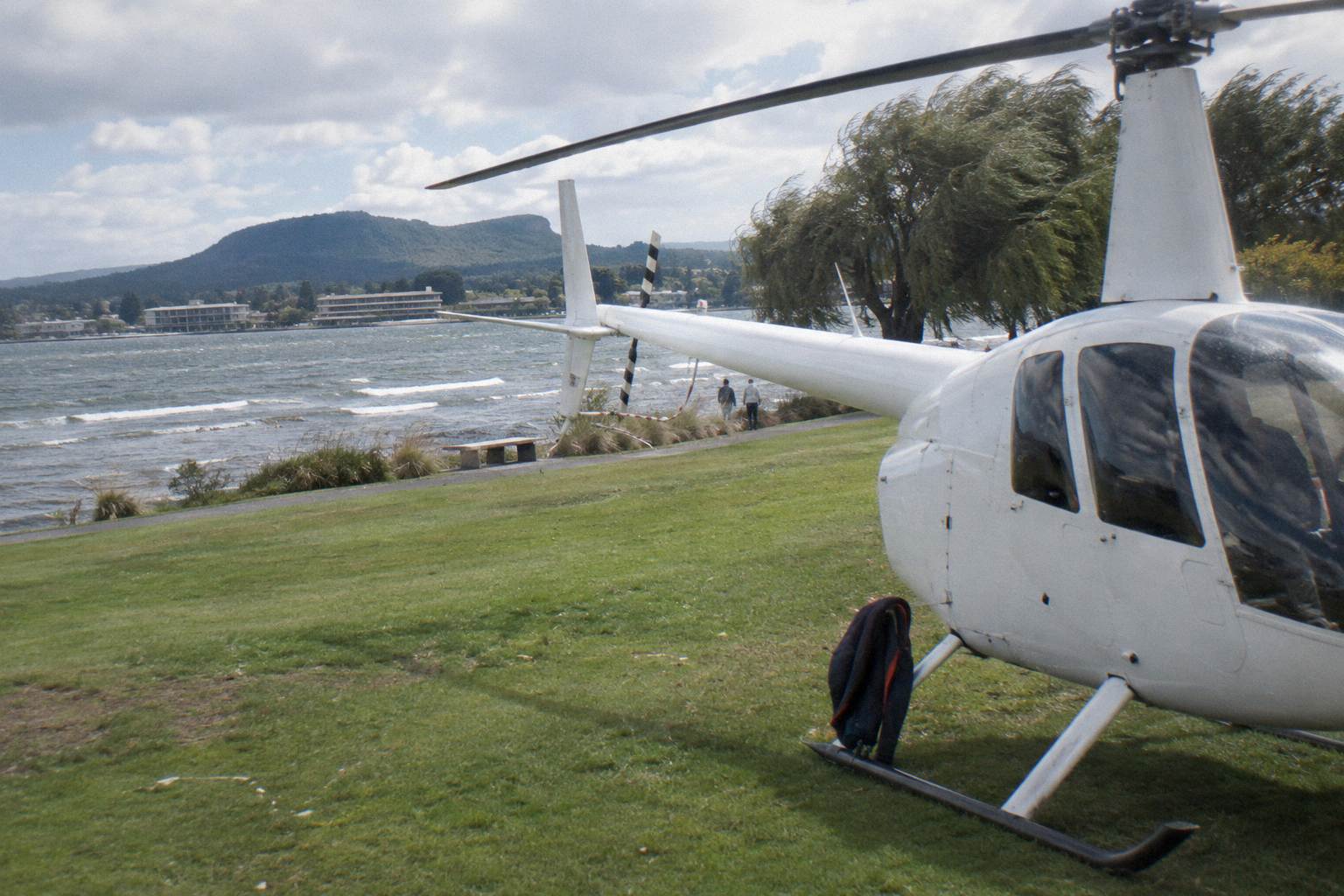
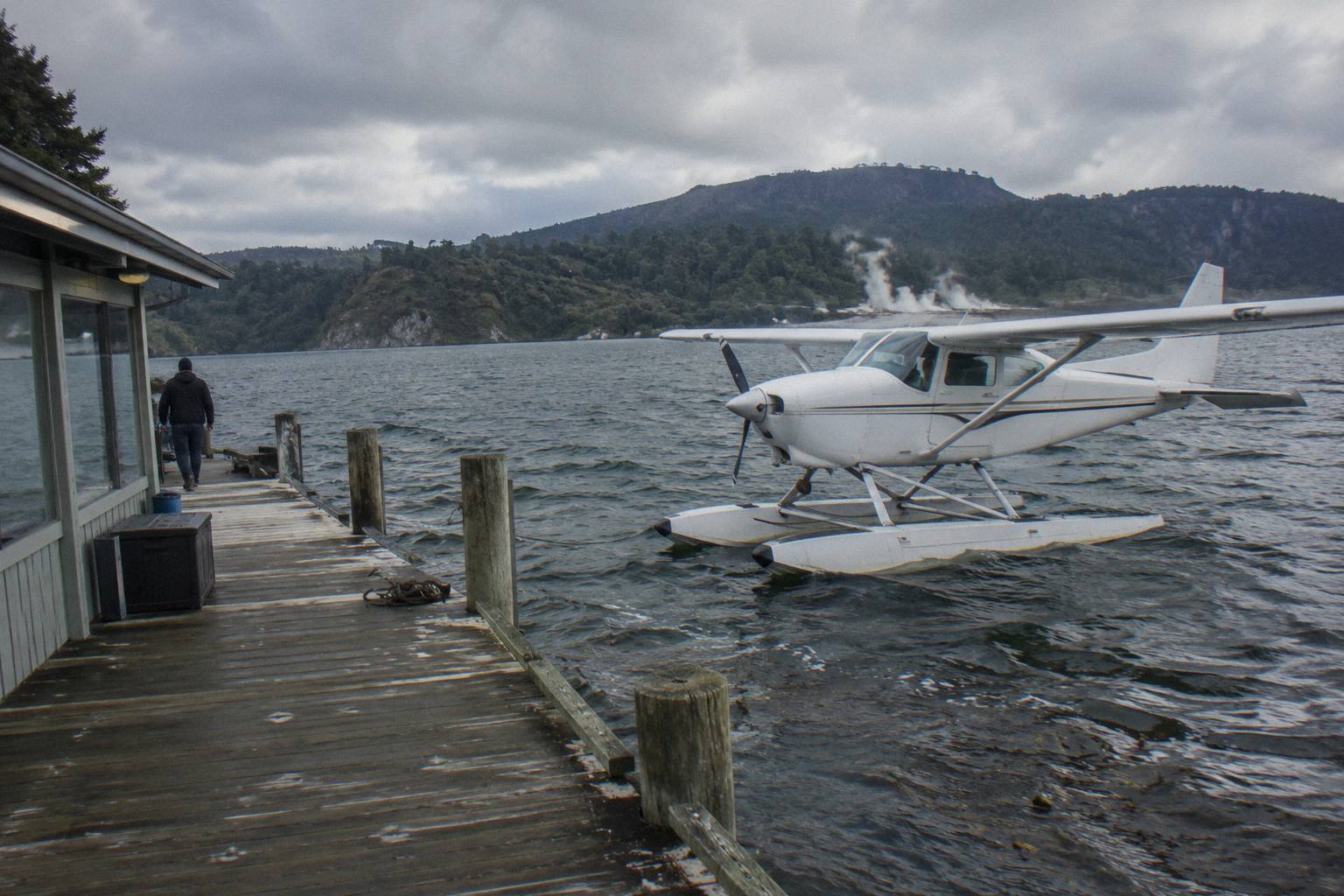
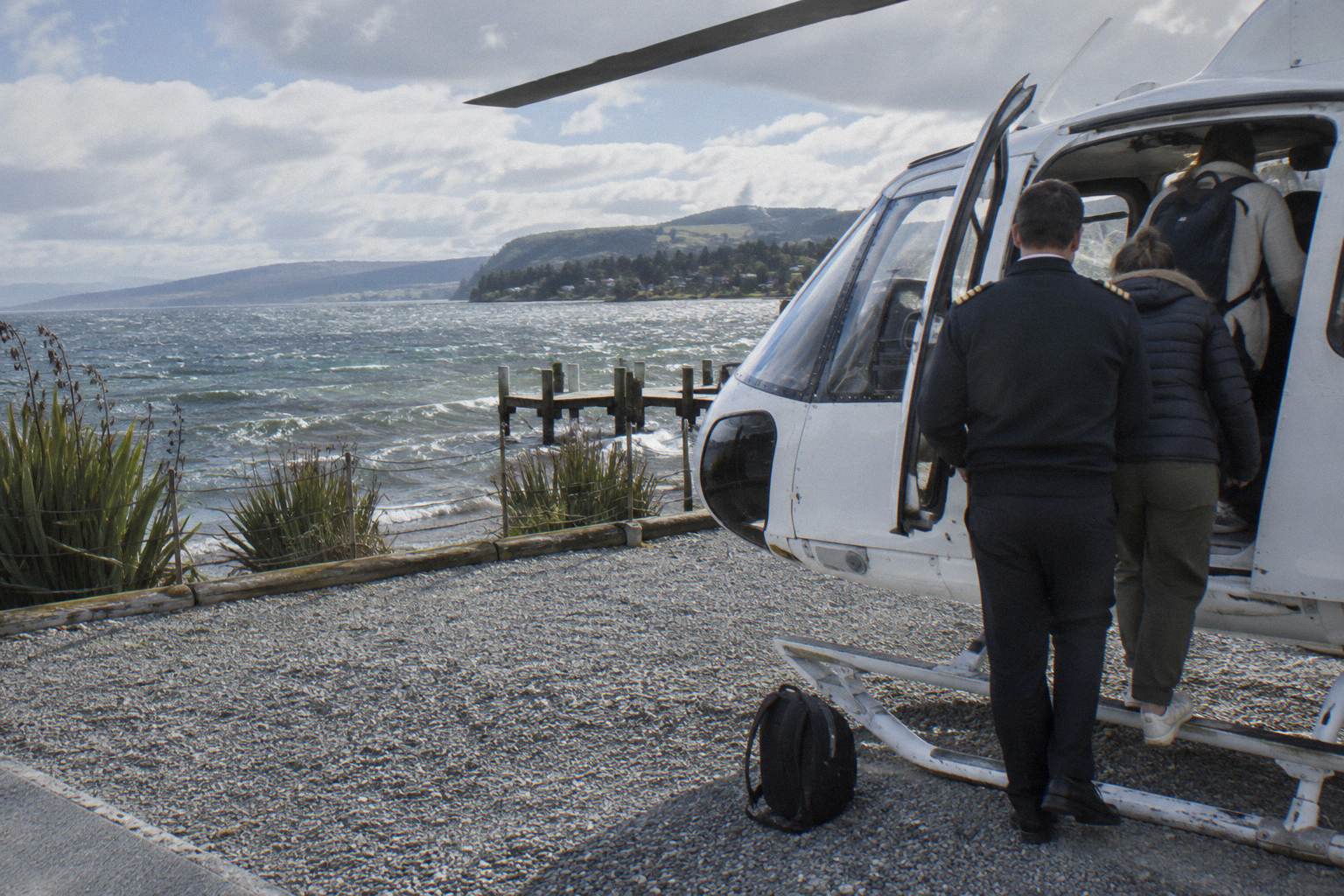
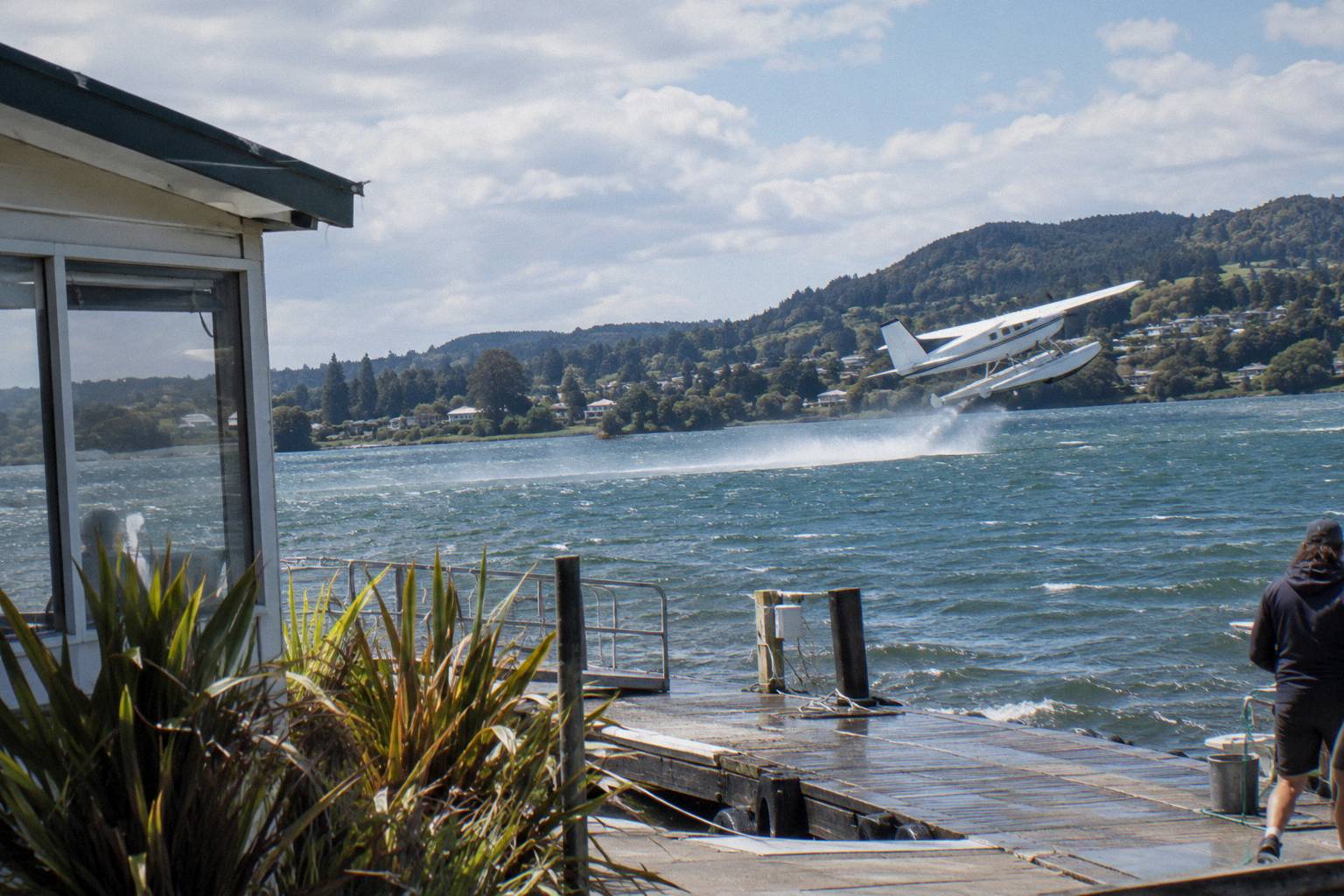
The base matters more than most visitors expect. The office sits at 1 Lakefront Drive, under a kilometre from the Rotorua town centre, which makes a flight an easy add-on to a day spent around Sulphur Bay or the lakefront path. Floatplanes take off from Lake Rotorua itself, from the lakefront pier, while helicopters use the pads beside it, so a mixed group could theoretically watch one aircraft type leave while waiting to board the other. The operator asks helicopter passengers to check in 30 minutes before departure and floatplane passengers 20 minutes before, for a full safety briefing at the Lakefront office.
Hotel pickup is not part of standard flights. The operator's FAQ is explicit that direct pick-ups are offered only for bespoke charters, so anyone staying outside walking distance of the town centre should plan the short drive or taxi to the Lakefront. The check-in questions people ask most often, from what to bring to children and pregnancy, are answered on the operator's FAQ page, and the booking-side terms are summarised later in the weights and cancellation section below.
What Flights Does Volcanic Air Actually Run?
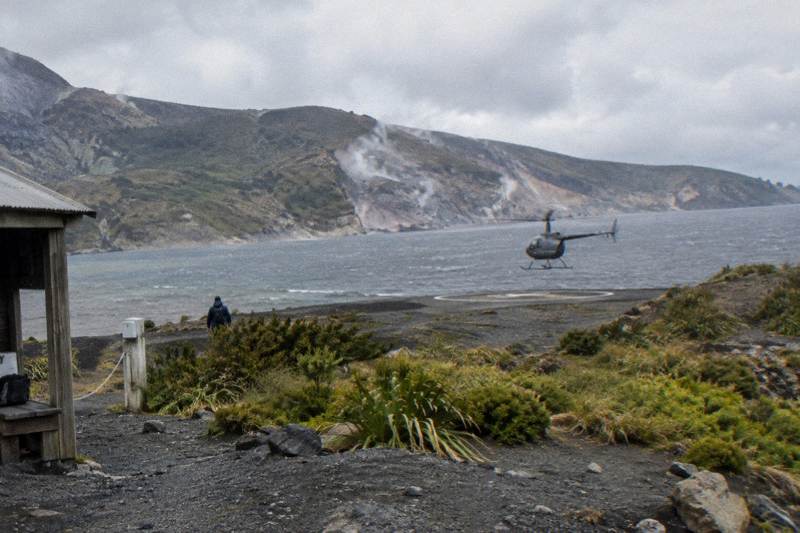
The line-up splits into two aircraft types and three kinds of experience: 15 minute crater lakes hops with no landing, longer flyovers of Tarawera, Waimangu and Whakaari, and landing trips that touch down on the Mt Tarawera summit or beside Orakei Korako. There are six helicopter trips and seven floatplane trips, every one departing from the Lakefront base, and the shortest costs from NZ$395 per person while the longest runs about three hours.
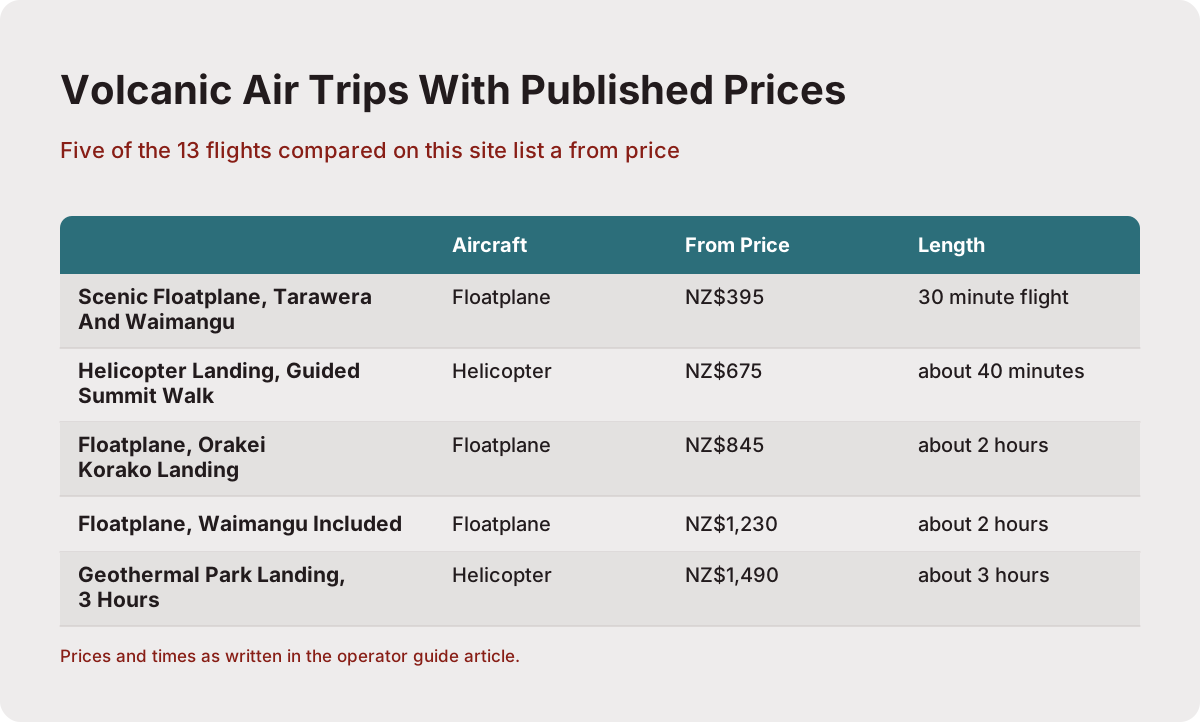
The fastest way to grasp the spread is a table. Prices are booking-page from-prices per person in New Zealand dollars, and each figure belongs to its own trip only.
| Trip (short name) | Aircraft | Landing | From price | Notes |
|---|---|---|---|---|
| Helicopter Volcano Landing | Helicopter | Mt Tarawera summit | Price on the booking page | Rated 4.9 from 43 reviews |
| Helicopter Landing, Guided Summit Walk | Helicopter | Mt Tarawera summit | NZ$675 | Total about 40 minutes with a guided walk |
| One-Hour Volcanic Adventure | Helicopter | Mt Tarawera summit | Price on the booking page | Around one hour |
| Geothermal Park Landing, 3 Hours | Helicopter | Mt Tarawera summit and Orakei Korako | NZ$1,490 | Total about 3 hours |
| Dual Landing Thermal Explorer | Helicopter | Mt Tarawera and Orakei Korako | Price on the booking page | Two landings, one day |
| Volcanic Extremes, 1h45m Helicopter | Helicopter | Mt Tarawera summit | Price on the booking page | Whakaari flyover included, about 1h45m |
| Crater Lakes By Helicopter, 15 Minutes | Helicopter | No landing (flyover) | Price on the booking page | 15 minute flight |
| Scenic Floatplane, Tarawera And Waimangu | Floatplane | No landing (flyover) | NZ$395 | 30 minute flight, rated 4.9 from 28 reviews |
| Tarawera Volcano Floatplane | Floatplane | No landing (flyover) | Price on the booking page | 30 minute flight |
| Floatplane, Orakei Korako Landing | Floatplane | Orakei Korako | NZ$845 | Total about 2 hours |
| Floatplane, Waimangu Included | Floatplane | No landing (flyover) | NZ$1,230 | Whakaari flyover, total about 2 hours |
| Floatplane, White Island And Tarawera | Floatplane | No landing (flyover) | Price on the booking page | Whakaari flyover |
| Crater Lakes By Floatplane, 15 Minutes | Floatplane | No landing (flyover) | Price on the booking page | 15 minute flight |
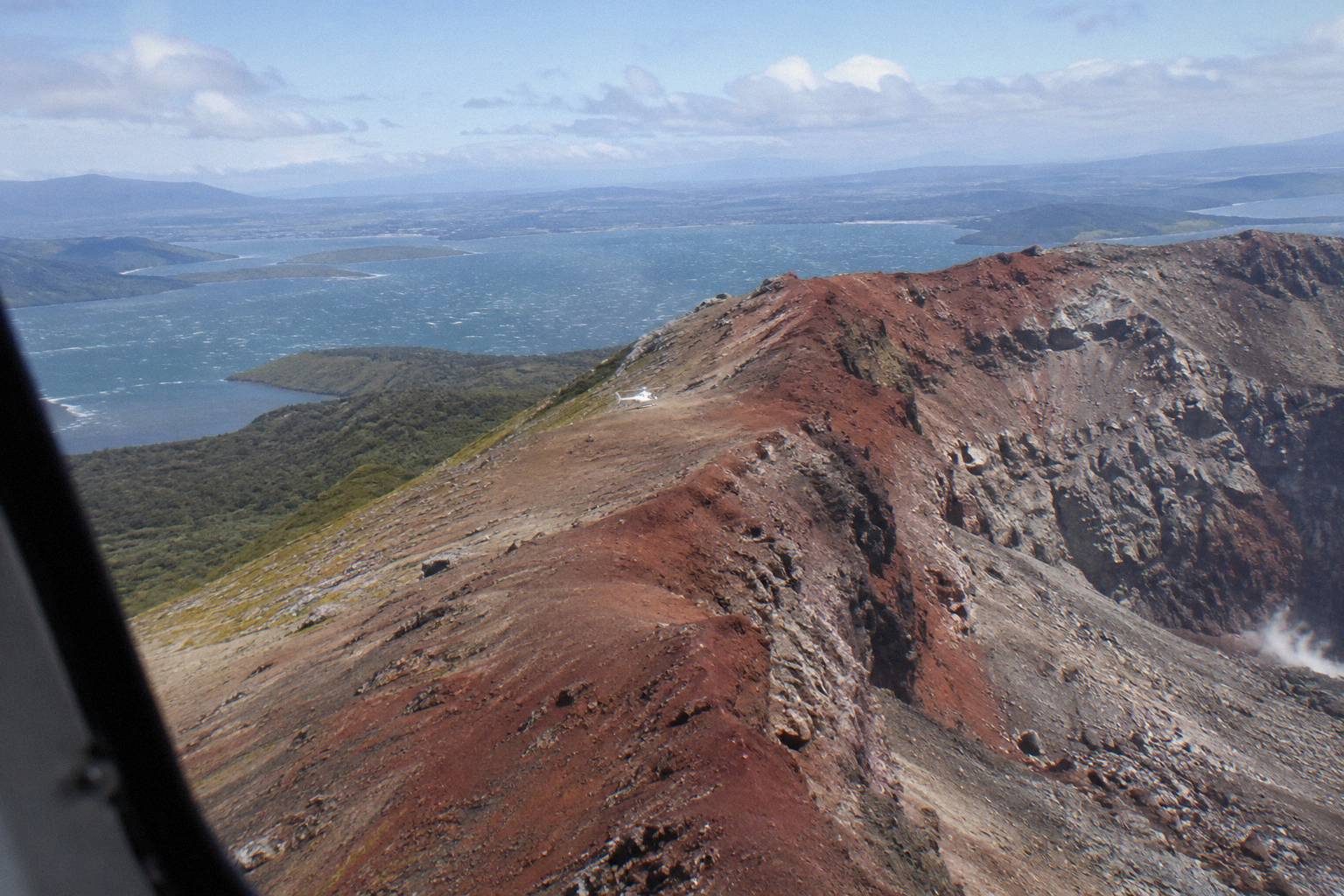
Three of these trips earn a place in almost every conversation. The Helicopter Volcano Landing is the classic Tarawera summit experience, with the strongest review pool on the line-up at 4.9 from 43 reviews. The Scenic Floatplane, Tarawera And Waimangu is the price floor, from NZ$395 per person, and still crosses the 1886 rift country from a lake take-off. The Helicopter Landing, Guided Summit Walk, from NZ$675, adds a guided walk on the summit that the bare landing trip leaves you to take in from the touchdown point.
Whakaari, or White Island, appears in three of the floatplane and helicopter trips as a flyover only. Landings on the island are suspended, and official guidance says there are currently no boat tours to the island and no helicopter flights that land on it, so any Volcanic Air trip naming White Island is a flight over an active offshore volcano about 48 km off the coast of Whakatane, not a landing. The White Island helicopter flights guide unpacks that in detail.
How Do You Tell The Thirteen Trips Apart?
Sort by three questions in order: do you want to land, how long do you want to be airborne, and helicopter or floatplane. Landing trips split into the Tarawera summit, Orakei Korako on the Waikato River, or both. Flyover trips split by length, from 15 minutes over the crater lakes to nearly two hours out over Whakaari. Aircraft type changes the take-off, the view angle and the price, in that order.
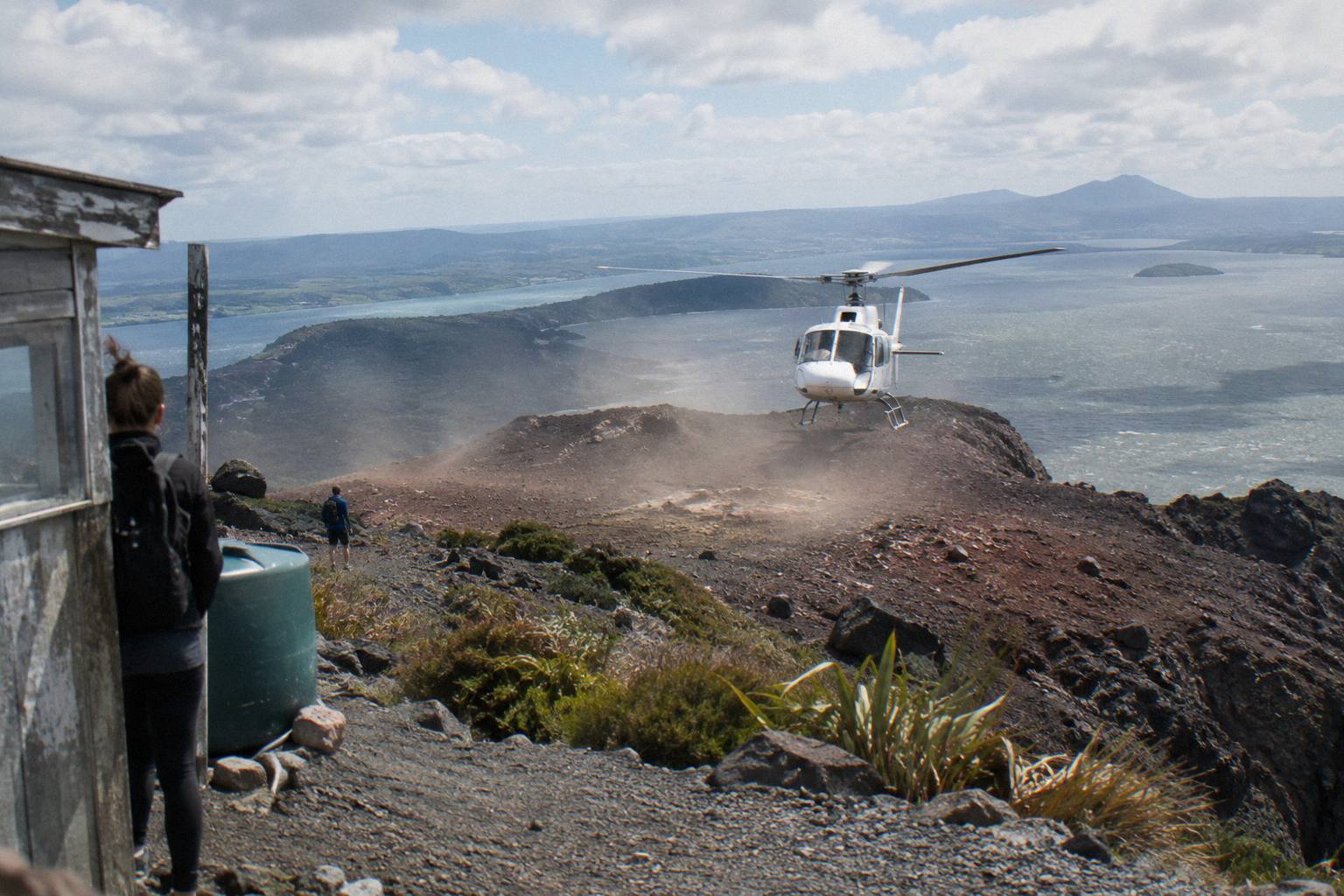
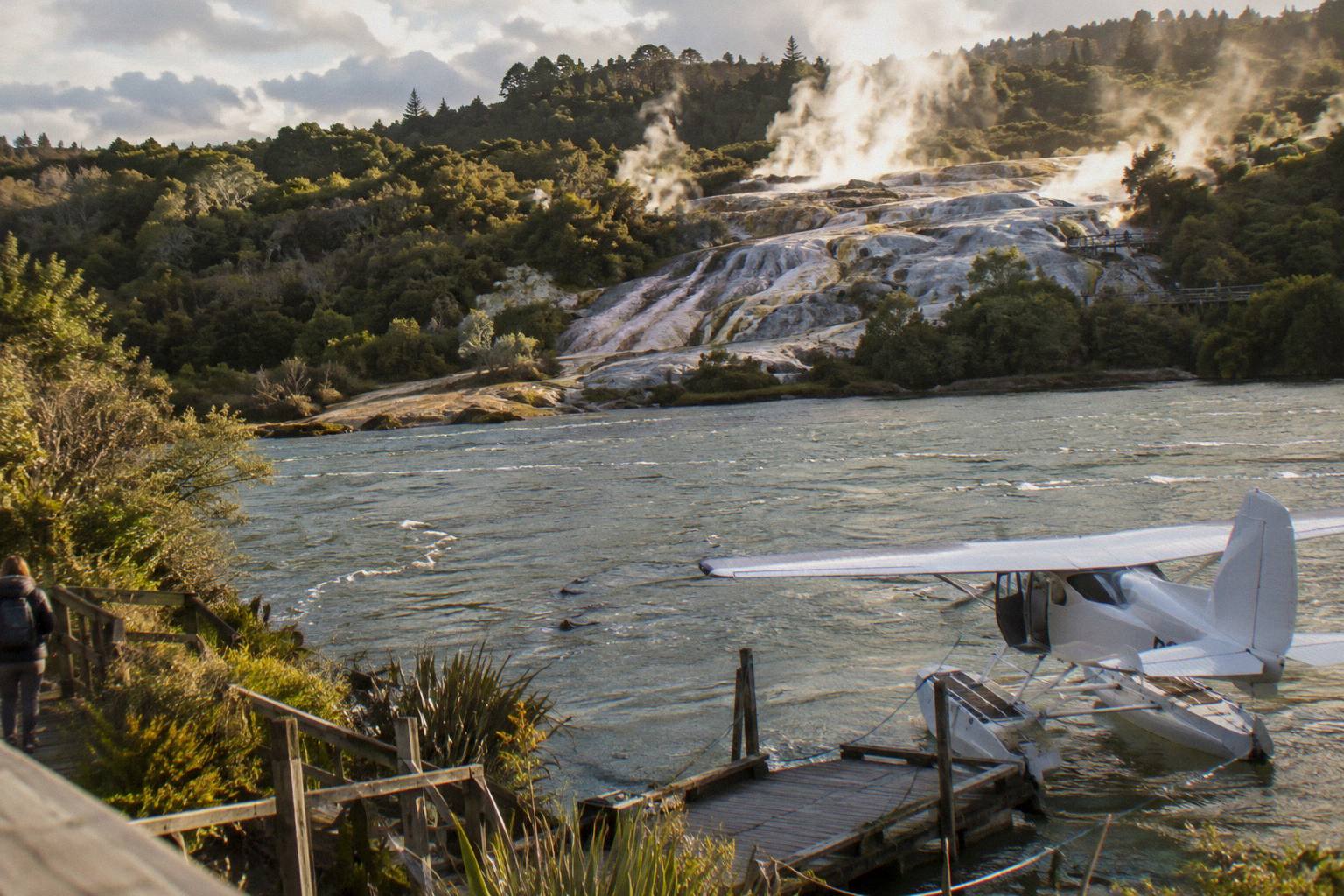
The landing question is the big money question. A Tarawera summit landing puts you on the cratered top of a volcano that erupted in 1886, on a guided walk described by the operator as about 15 minutes on its landing flights. An Orakei Korako landing is gentler and longer: the floatplane touches down on the Waikato River and the geothermal field is reached by a short ferry ride across Lake Ohakuri, since the park says its field is only accessible by boat. The dual landing and three hour geothermal park trips combine both into one day.
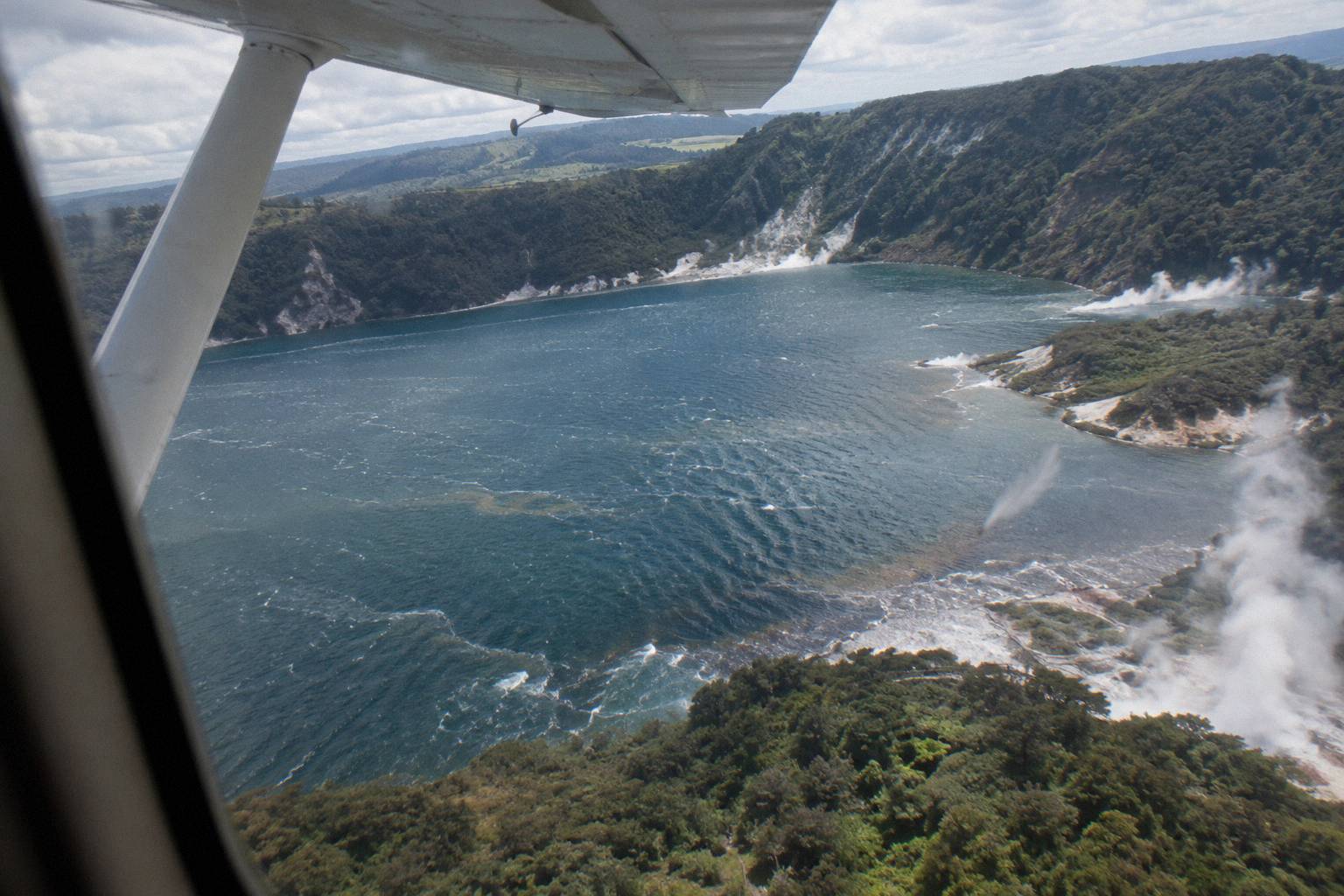
The duration question does the rest of the sorting. A 15 minute Crater Lakes flight, by either aircraft type, is a taste of the region: the operator's flight wording names lakes Rotoiti, Okataina, Tarawera, Okareka, Rotomahana, Rotokakahi and Tikitapu, and describes views of 12 distinct crater lakes. A 30 minute floatplane adds Waimangu Valley, the geothermal valley formed along the line of the 1886 rift. The longest trips, about 1 hour 45 minutes and beyond, head out over Whakaari, which is where the line-up's time and price ceiling sits.
Aircraft type is partly preference and partly physics. Floatplanes take off from Lake Rotorua, a water take-off that many visitors book for its own sake, while helicopters lift from the pads beside the pier and can land on the mountain top. Only helicopters carry the Tarawera summit landing; floatplanes in the line-up land at Orakei Korako or stay airborne. The Rotorua helicopter versus floatplane guide works through that choice at length.
If one trip sits closest to the middle of the matrix, it is the Mt Tarawera Helicopter Tour with Volcano Landing, the featured trip on the Tarawera volcano landing page: a helicopter, a summit landing, a duration short enough to leave the rest of the day free, and the strongest review pool of the thirteen.
One more sorting fact worth knowing before you commit: a Tarawera landing is never guaranteed. The operator's own wording says excursion landings are undertaken at your own risk and are at your pilot's sole discretion, and that tour duration, flight times and inclusions may vary due to weather conditions, volcanic activity and passenger loadings. That applies to every landing trip in the table above, and it is the single most common surprise for visitors who assumed a summit touchdown was part of the ticket the way a seat is.
What Do The Rules Say About Volcanic Air's Operation?
Helicopter and small aeroplane scenic operations in New Zealand sit under Civil Aviation Rule Part 135, titled "Air operations: helicopters and small aeroplanes", which applies to the holder of an air operator certificate. Volcanic Air describes itself as an approved NZ Civil Aviation Authority certified operator, independently assessed through a quality assurance programme. No certificate number is published here, because none was verified on a public register.
The distinction matters because certification wording gets thrown around loosely in travel copy. The general rule, that Part 135 governs these operations and refers to the holder of an air operator certificate, is public regulation. The operator's specific standing is its own claim: "approved by the New Zealand Civil Aviation Authority and independently assessed via a stringent Quality Assurance Program". Both statements can sit in the same article, attributed correctly, and a reader comparing operators should want exactly that separation between regulation and marketing. The operator's terms page carries the risk and cancellation clauses those certifications sit behind.
The terms also describe the operating environment plainly: flights land and take off on hard terrain or water, and natural hazards named include earthquakes, geothermal activity, landslides and fast changing weather. That is the risk context for the landings discussed above, and it is why weather holds the final word on every departure. If a flight cannot go ahead due to weather, the operator says it will work with passengers to reschedule or provide a full refund, and if the operator cancels before commencement for circumstances beyond its control, including weather and volcanic activity, the terms provide a full refund.
What Are The Weight, Child And Cancellation Terms?
Weights are declared at booking and checked on arrival, with a possible surcharge over 110 kg and a second adult fare required over 135 kg as weighed. Children of all ages are welcome, under 2s sit on a lap and 2 to 11 year olds pay child rates. Booked through the booking page, trips carry free cancellation up to 24 hours in advance for a full refund, and operator weather cancellations are refunded in full.
The weight system exists for balance, not judgement: the FAQ asks for individual weights at booking so the aircraft stays within balance limits, and passengers are weighed on arrival. The terms add that any deviation from a declared weight may result in a flight being rescheduled, a surcharge being applied, or a booking being cancelled, at the operator's sole discretion. The One-Hour Volcanic Adventure flight, for example, carries a maximum of 6 travellers and a total weight per passenger of 110 kg. The weight limits guide covers what to expect on the day.
| Term | What applies |
|---|---|
| Weight declaration | Individual weights at booking, weighed on arrival |
| Over 110 kg | Surcharge may apply at operator's sole discretion |
| Over 135 kg | Two adult fares as weighed |
| Children | All ages welcome; under 2 on a lap; child rates 2 to 11 |
| Tarawera landing flights | Minimum 2 adult fares; 2 to 11 pay 75% of the adult fare |
| Guest cancellation | Free cancellation, up to 24 hours in advance, full refund |
| Weather cancellation | Operator reschedules or refunds in full |
Pregnancy and mobility are not automatic barriers, according to the FAQ, but both need a conversation before booking: expectant mothers are advised to talk to a maternity carer, especially from 28 weeks, and to contact the operator with a due date, while mobility needs should be raised at booking so assistance can be agreed. On board, every passenger follows the safety briefing, stays seated and secured, and boards and leaves the aircraft as arranged. The rest of the planning pages sit on Rotorua Helicopter Tours.
The one trip in the line-up that best rewards reading the terms carefully is the Rotorua: Volcano Landing and Geothermal Park Helicopter Tour, from NZ$1,490 per person: three hours, two very different landings, and more weather exposure than any other trip here.
Helicopter Or Floatplane With Volcanic Air?
Choose the helicopter for the Tarawera summit landing and a vertical view of the rift craters; choose the floatplane for a water take-off from Lake Rotorua, the Orakei Korako river landing, and the lower from-price on a scenic crossing. Six of the thirteen trips are helicopters and seven are floatplanes, and the line-up is built so most travellers can match aircraft to itinerary rather than compromise.
The floatplane experience starts differently: the aircraft departs from the city centre lakefront pier and takes off from Lake Rotorua itself, climbing around Mokoia Island, which the operator describes as a native bird sanctuary, with views over Sulphur Bay and the city before heading south. The Floatplane Flight with Orakei Korako Landing, from NZ$845 per person for about two hours total, is the signature version: the pilot touches down on the winding Waikato River, and the return leg crosses farmland and the Paeroa Range. The park itself says boats to the geothermal field leave on request rather than a timetable, a detail worth knowing when estimating the two hours.
Helicopters trade the water take-off for flexibility at the far end. Only a helicopter can set down on the Mt Tarawera summit, which is why every summit landing trip in the table earlier is a helicopter trip. The Volcanic Extremes helicopter trip, about one hour 45 minutes, is the line-up's longest helicopter day: a Whakaari flyover plus a Tarawera landing in one booking, though its review pool is small, only 2 reviews.
For a first flight, or a short one, the aircraft choice mostly comes down to which take-off you want to watch. The Crater Lakes By Helicopter trip covers the same lakes as its floatplane twin in the same 15 minutes, and neither lands, so the decision is between lifting off from the pad and lifting off from the lake.
What Is The Best Time Of Year To Fly With Volcanic Air?
Volcanic Air operates all months of the year during daylight hours, so the season matters less than the weather on the day. The driest, warmest stretch in Rotorua runs from late spring in October to early autumn in April, and mornings tend to give the calmest conditions and smoothest flying. Every flight is weather dependent and will not go ahead if it is not safe or if the views cannot be seen.
The monthly rainfall pattern supports the seasonal advice, using Rotorua's 1991 to 2020 climate normals, and the spread across the year is easier to read in full than in fragments.
| Month | Average rainfall (mm) |
|---|---|
| January | 93.8 |
| February | 100.4 |
| March | 100.3 |
| April | 133.0 |
| May | 130.2 |
| June | 131.9 |
| July | 137.4 |
| August | 125.2 |
| September | 106.6 |
| October | 92.9 |
| November | 86.8 |
| December | 117.1 |
The driest months sit at 86.8 mm in November and 92.9 mm in October, and the wettest at 137.4 mm in July. Winter flights still run, and the operator notes afternoon winter flights can carry late day colour and warmer temperatures, but the odds of a clear window are simply better from October to April, which Rotorua's official tourism FAQ confirms as the driest and warmest period.
Time of day interacts with aircraft type. A morning floatplane take-off from a glass calm lake is a different sight from a choppy afternoon one, and soft morning light favours photography over the lakes. The trade-off is that mornings in winter are cold on an exposed jetty, so the operator's advice to bring a jacket applies year round, with closed-toe comfortable footwear specifically recommended for flights with landings.
Common Mistakes When Comparing Rotorua Flight Operators
The recurring mistakes are assuming a landing is guaranteed, comparing trips only on price while ignoring duration and aircraft, arriving at the Lakefront without the check-in buffer, declaring a convenient rather than true weight, and treating a Whakaari flyover trip as if it lands on the island. Every one of these is avoidable by matching the trip table above to your own constraints before booking, and by reading the operator's own conditions rather than a summary.
The first mistake is the costliest. Booking a Tarawera landing trip and expecting a touchdown as of right sets up disappointment on a day when wind, volcanic activity or loadings make the pilot decline the landing. The operator's wording could not be clearer: landings are at the pilot's sole discretion and undertaken at your own risk. Plan for the flight being worth it without the landing, and treat the landing as the best case.
The second is comparing NZ$395 with NZ$1,490 as if both were the same product. The Scenic Floatplane, Tarawera And Waimangu is a 30 minute flight with no landing; the Geothermal Park Landing trip is about three hours with two landings and a geothermal park visit. Per minute of experience the gap narrows dramatically, and per landing it disappears entirely. Price comparisons only mean something inside one aircraft and duration class.
The third and fourth mistakes happen at the Lakefront. Helicopter passengers need 30 minutes of check-in before departure and floatplane passengers 20, and that buffer is for the safety briefing, not paperwork you can skip. And the weigh-in on arrival is compared against the weight declared at booking: the terms say a deviation may mean rescheduling, a surcharge or cancellation at the operator's sole discretion, so declaring accurately protects your own day.
The fifth mistake is geographic. Whakaari lies about 48 km off the coast of Whakatane, and landings are suspended, so the White Island trips in the line-up are flyovers of an active offshore volcano, seen from altitude, paired in some cases with a Tarawera landing back over the mainland. Anyone booking the Volcanic Extremes or a White Island floatplane trip expecting to stand on the island will not, and official guidance is blunt that no flights currently land there. For more on that, see whether you can fly over Whakaari in the Whakaari flyover or landing guide.
Common Questions About The Rotorua Flight Operator
Is Volcanic Air The Only Flight Operator In Rotorua?
Other aviation businesses exist in and around Rotorua, but no facts about them were verified for these comparisons, so none are described here. Every flight compared in these pages, all 13 of them, is operated by Volcanic Air from the Lakefront base at 1 Lakefront Drive.
How Long Has Volcanic Air Been Flying?
The operator states it has been flying in Rotorua since 1992. Its home page also describes the company as a Civil Aviation Authority certified NZ air operator and Qualmark Gold assured under Tourism New Zealand's quality scheme, both in the operator's own words.
Where Does Volcanic Air Take Off From?
All trips check in at the Rotorua City Lakefront office at 1 Lakefront Drive, Rotorua 3010, under a kilometre from the town centre. Floatplanes take off from Lake Rotorua at the lakefront pier, and helicopters depart from the pads alongside. Hotel pickup is not part of standard flights.
Which Volcanic Air Trip Is The Cheapest?
The Scenic Floatplane, Tarawera And Waimangu flight is the lowest from-price on the line-up at NZ$395 per person for a 30 minute flight, rated 4.9 from 28 reviews. The 15 minute crater lakes trips by either aircraft print no price here, so compare live availability before assuming they cost less.
Can Volcanic Air Land On White Island?
No. Landings on Whakaari, or White Island, are suspended, and official guidance says there are currently no boat tours or helicopter flights landing on the island. The White Island trips in the line-up are flyovers, some paired with a Mt Tarawera landing on the mainland.
Is The Mt Tarawera Landing Guaranteed On Volcanic Air Flights?
No. The operator's terms say excursion landings are undertaken at your own risk and at the pilot's sole discretion, and that duration and inclusions may vary with weather, volcanic activity and passenger loadings. If weather prevents a flight entirely, the operator reschedules or refunds in full.