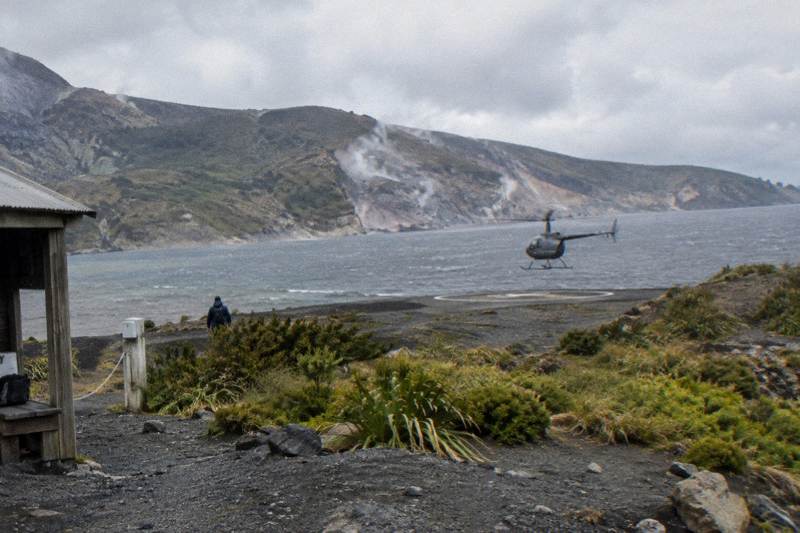
Helicopter Ride Rotorua: Flights, Landings, And Who They Suit
Rotorua's flight menu runs from a 15-minute crater lakes hop to a three-hour dual-landing expedition. Here is every ride on the line-up, side by side, with the landing each one makes and the traveller it fits.
Short answer
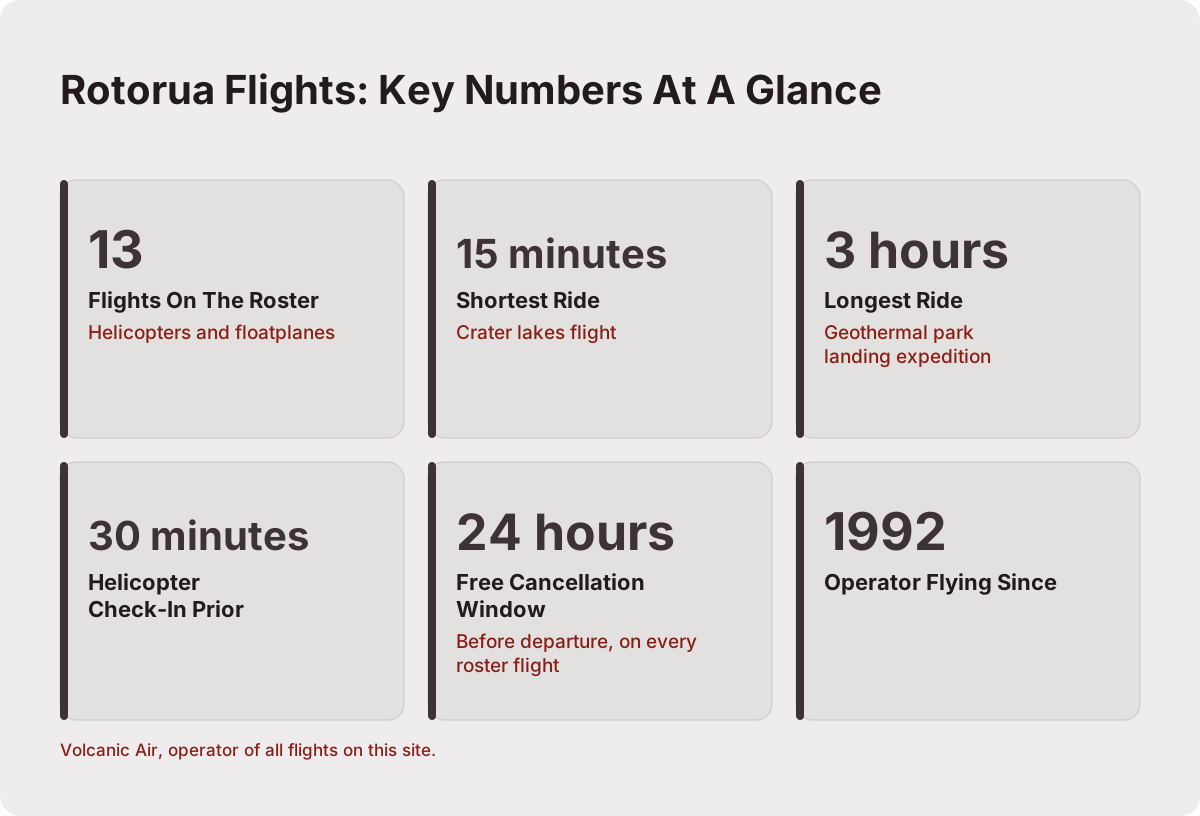
A helicopter ride over Rotorua starts at the Lakefront base at 1 Lakefront Drive, with check-in 30 minutes before departure. Options run from a 15-minute crater lakes flight to Mt Tarawera summit landings and longer geothermal expeditions, from NZ$395 per person for the floatplane scenic flight, and amounts are in New Zealand dollars.
For the wider picture of every operator and aircraft in the region, start with the scenic flights overview for Rotorua; the breakdown below is the flight menu itself.
| Quick fact | Detail |
|---|---|
| Departure point | Lakefront, 1 Lakefront Drive, Rotorua 3010 |
| Check-in | 30 minutes prior for helicopters, 20 minutes prior for floatplanes |
| Operator | Volcanic Air, flying in the region since 1992 |
| Flights on the line-up | 13, helicopters and floatplanes |
| Shortest ride | 15-minute crater lakes flight |
| Longest ride | 3-hour geothermal park landing expedition |
| Free cancellation | Up to 24 hours before departure, on every flight |
| Best season window | Late spring to early autumn for the driest weather |
What A Helicopter Ride Over Rotorua Actually Includes
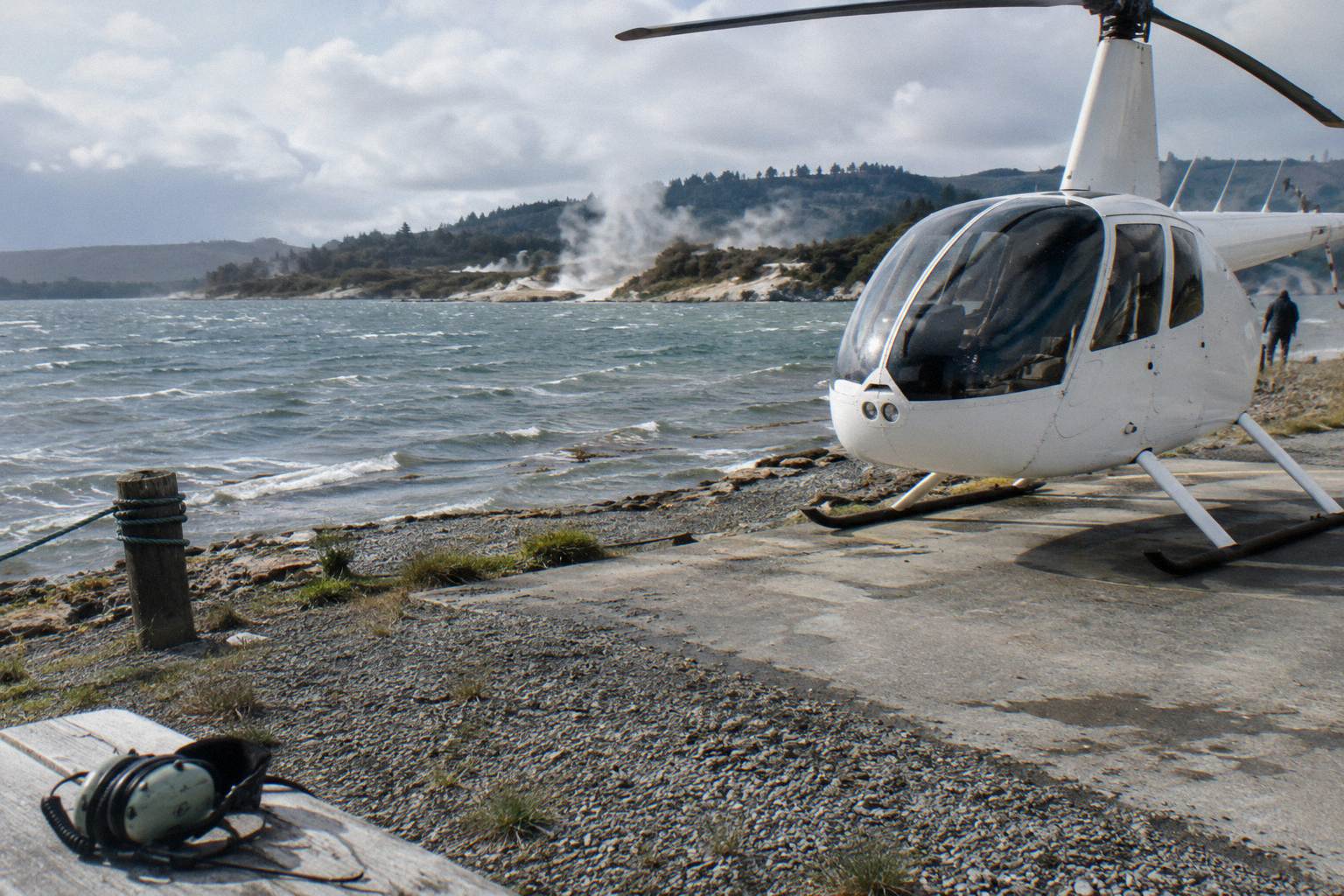
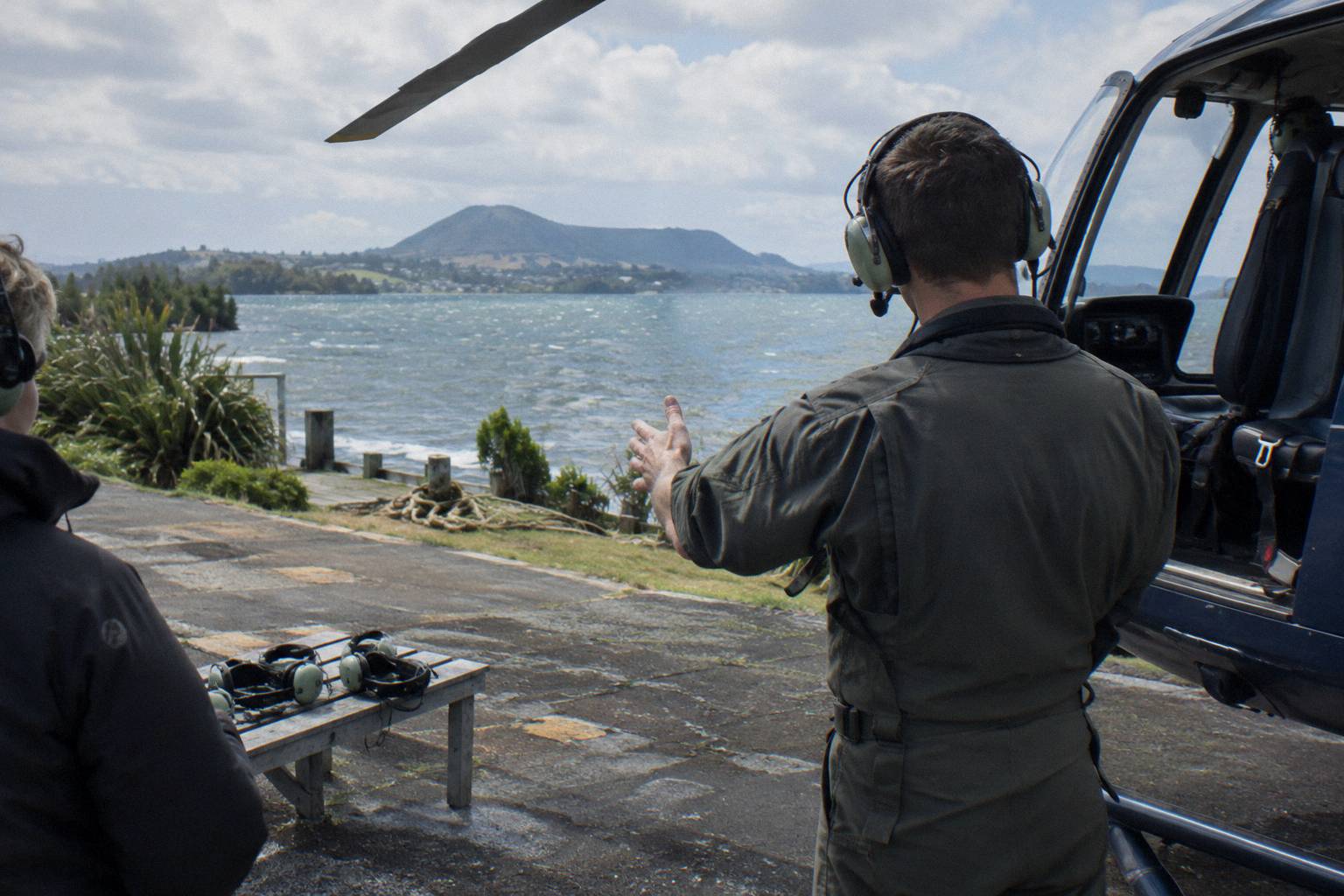
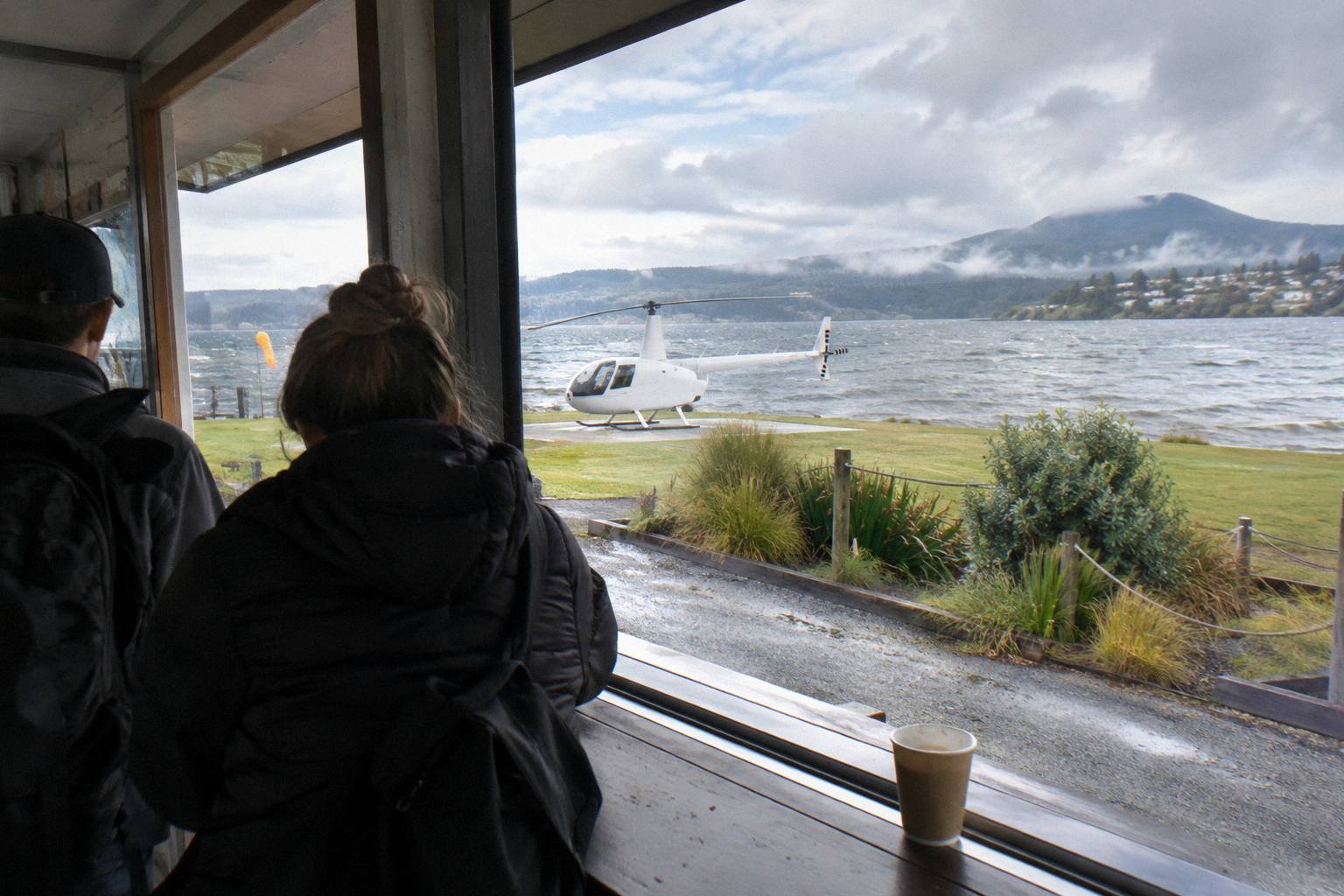
Every ride on the line-up departs from one base, the Lakefront office at 1 Lakefront Drive, where check-in includes a full safety briefing 30 minutes before a helicopter departure or 20 minutes before a floatplane. From there helicopters lift from the pad and floatplanes take off from Lake Rotorua itself at the lakefront pier. Hotel pickup is not part of standard flights, so plan to make your own way to the lakefront.
The base sits under 1 km from the Rotorua town centre, which makes a flight one of the few attractions in the region that needs no driving, no shuttle and no parking decision. The operator, Volcanic Air, has been flying in the region since 1992 and describes itself as a CAA-certified air operator and Qualmark Gold assured. That matters less as a badge and more as a signal: this is a working airline-style operation with briefings, weight checks and weather calls, not a carnival ride.
What the briefing covers is set out in the operator's own frequently asked questions page: check-in procedure, what to bring, and the conditions that apply on the day. Bring a camera, sunglasses and a jacket, and closed-toe comfortable footwear if your flight includes a landing, because summit ground is uneven volcanic rock rather than a formed path.
One structural point shapes the whole menu. Rotorua flights are not interchangeable loops of the same scenery. The short hops stay over the lake district, the Tarawera flights fly southeast to the volcano, and the long expeditions string several regions together. Price, duration and landing all scale together, which is why comparing the menu first, before picking a flight, saves both money and disappointment.
The Full Flight Menu: Every Ride By Minutes And Landing
The line-up breaks into four bands: 15-minute crater lakes flights with no landing, roughly 30 to 40 minute Tarawera flyovers, Tarawera flights with a summit landing and guided walk, and multi-hour expeditions that add Orakei Korako, Waimangu or Whakaari. The table below lists every ride with its aircraft, its flight time and whether it lands, so you can filter by the one variable that matters most to you.
| Ride (short name) | Aircraft | Time in the air / total | Landing |
|---|---|---|---|
| Crater Lakes By Helicopter, 15 Minutes | Helicopter | 15 minutes | No landing (flyover) |
| Crater Lakes By Floatplane, 15 Minutes | Floatplane | 15 minutes | No landing (flyover) |
| Scenic Floatplane, Tarawera And Waimangu | Floatplane | 30 minutes flight, 40 total | No landing (flyover) |
| Tarawera Volcano Floatplane | Floatplane | 30 minutes | No landing (flyover) |
| Helicopter Landing, Guided Summit Walk | Helicopter | 40 minutes total | Mt Tarawera summit |
| Helicopter Volcano Landing | Helicopter | Tarawera flight | Mt Tarawera summit |
| One-Hour Volcanic Adventure | Helicopter | About one hour | Mt Tarawera summit |
| Volcanic Extremes, 1h45m Helicopter | Helicopter | 1 hour 45 minutes total | Mt Tarawera summit, Whakaari flyover |
| Dual Landing Thermal Explorer | Helicopter | Extended expedition | Mt Tarawera and Orakei Korako |
| Geothermal Park Landing, 3 Hours | Helicopter | 3 hours total | Mt Tarawera summit and Orakei Korako |
| Floatplane, Orakei Korako Landing | Floatplane | 2 hours total | Orakei Korako, on the Waikato River |
| Floatplane, Waimangu Included | Floatplane | 2 hours total | No landing, flyover only |
| Floatplane, White Island And Tarawera | Floatplane | Extended flight | No landing, flyover only |
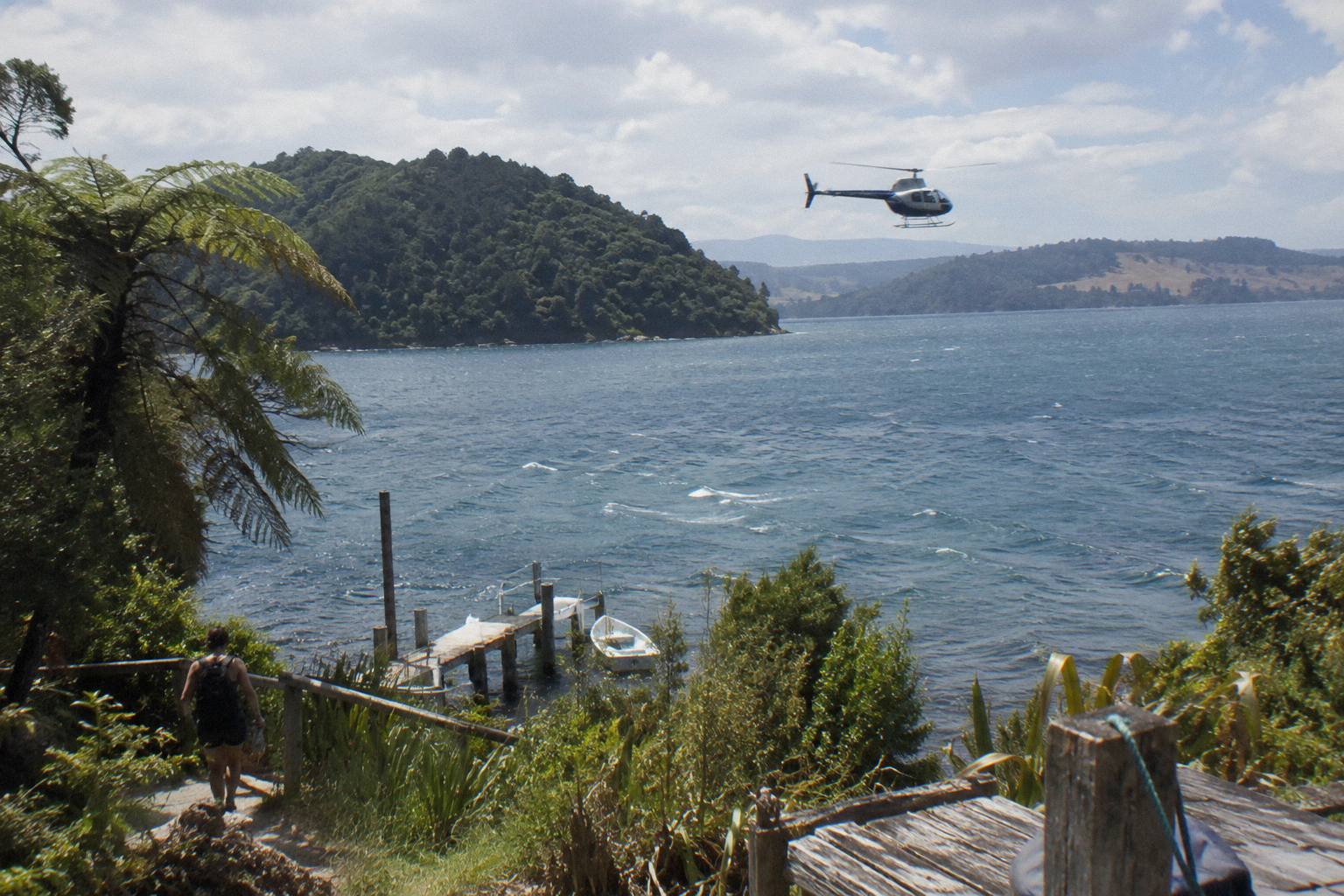
Read the table with two filters in mind. The first is the landing. A Tarawera summit landing is the experience most visitors picture when they imagine a Rotorua helicopter ride, and only the helicopter flights in the middle of the table offer it; every floatplane Tarawera flight is a flyover, because floatplanes land on water, not on mountain rock. The second filter is time. If your day is packed with Rotorua's geothermal parks and the lakefront itself, a 15-minute hop or a 40-minute Tarawera loop fits; the three-hour expeditions are half-day commitments that deserve a clear morning.
Three rides cover most decisions. The Mt Tarawera Helicopter Tour with Volcano Landing, rated 4.9 across 43 reviews, is the straight Tarawera summit experience. The Scenic Flight over Mt Tarawera & Waimangu Valley, from NZ$395 per person, is the value pick for flyers who want the volcano from the air without a landing. And the Helicopter Flight and Guided Walk on Mt Tarawera, from NZ$675 per person, adds a guided summit walk to the touchdown. Amounts throughout are New Zealand dollars.
Helicopter Or Floatplane: How The Rotorua Fleet Differs
Helicopters and floatplanes in Rotorua fly much of the same scenery but behave differently: helicopters can land on the Tarawera summit, hover logic suits ridge crossings, and seats face the view; floatplanes take off from and land on water, which makes Orakei Korako's river landing their signature move and keeps every Tarawera floatplane flight a flyover. Choose the aircraft by the landing you want, not by the aircraft itself.
The split runs right through the line-up. Both 15-minute crater lakes flights exist in twin form, helicopter and floatplane, at the same duration, which makes them a pure aircraft preference. The Tarawera flights fork hard: helicopters land on the summit, floatplanes cross the lakes and the mountain and return without touching down. And Orakei Korako is floatplane territory by design, because the operator's own page for the flight describes the pilot touching down on the winding Waikato River beside the geothermal field, something no helicopter on the line-up does there.
| Question | Helicopter flights | Floatplane flights |
|---|---|---|
| Tarawera summit landing | Yes, on the landing flights | No, flyover only |
| Take-off and landing surface | Land pad at the Lakefront | Lake Rotorua and rivers |
| Orakei Korako access | Landing flights pair it with Tarawera | Direct river landing beside the field |
| Crater lakes 15-minute option | Yes | Yes |
| Whakaari flyover | One flight, 1h45m with Tarawera landing | Two floatplane flights |
The floatplane take-off itself is part of the appeal for many flyers: the aircraft accelerates along the surface of Lake Rotorua before lifting off, and climbs around Mokoia Island, which the operator describes as a native bird sanctuary, on the way out. Helicopters trade that waterborne start for vertical agility over the ridges and the ability to set down on a volcano. Neither is the better aircraft; they are different tools, and the deeper comparison, including seat positions and motion, sits in the helicopter versus floatplane breakdown.
One decision shortcut works for most travellers. If standing on a volcano matters, book a Tarawera helicopter landing flight and stop comparing. If the money or the stomach prefers staying airborne, a floatplane Tarawera and Waimangu flyover delivers the rift, the lakes and the valley in one 30-minute flight. If geothermal parks on the ground are the goal, the dual-landing and geothermal-park expeditions combine flying with two ground visits, which is a category the floatplanes cannot match.
The Tarawera Landing Flights Compared
Five helicopter rides land on the Mt Tarawera summit: the Guided Summit Walk, the Volcano Landing tour, the One-Hour Volcanic Adventure, the Volcanic Extremes flight and the two long expeditions. They share the same landing, governed by the same rules, and differ in flight time, what else they cover and whether a guided walk is included. All are subject to the pilot's sole discretion on the day.
The landing itself deserves a clear explanation, because it is the product. The operator's Tarawera landing flight page describes flying over the mountain's 8 km of rift and craters, then landing on the summit for a guided walk. GNS Science's Tarawera fact sheet records the full rift at 17 km long, running across the mountain top, through Lake Rotomahana and into the Waimangu Valley area; the operator's 8 km figure describes the stretch over the mountain itself. Two spans, two sources, both true at their own scale.
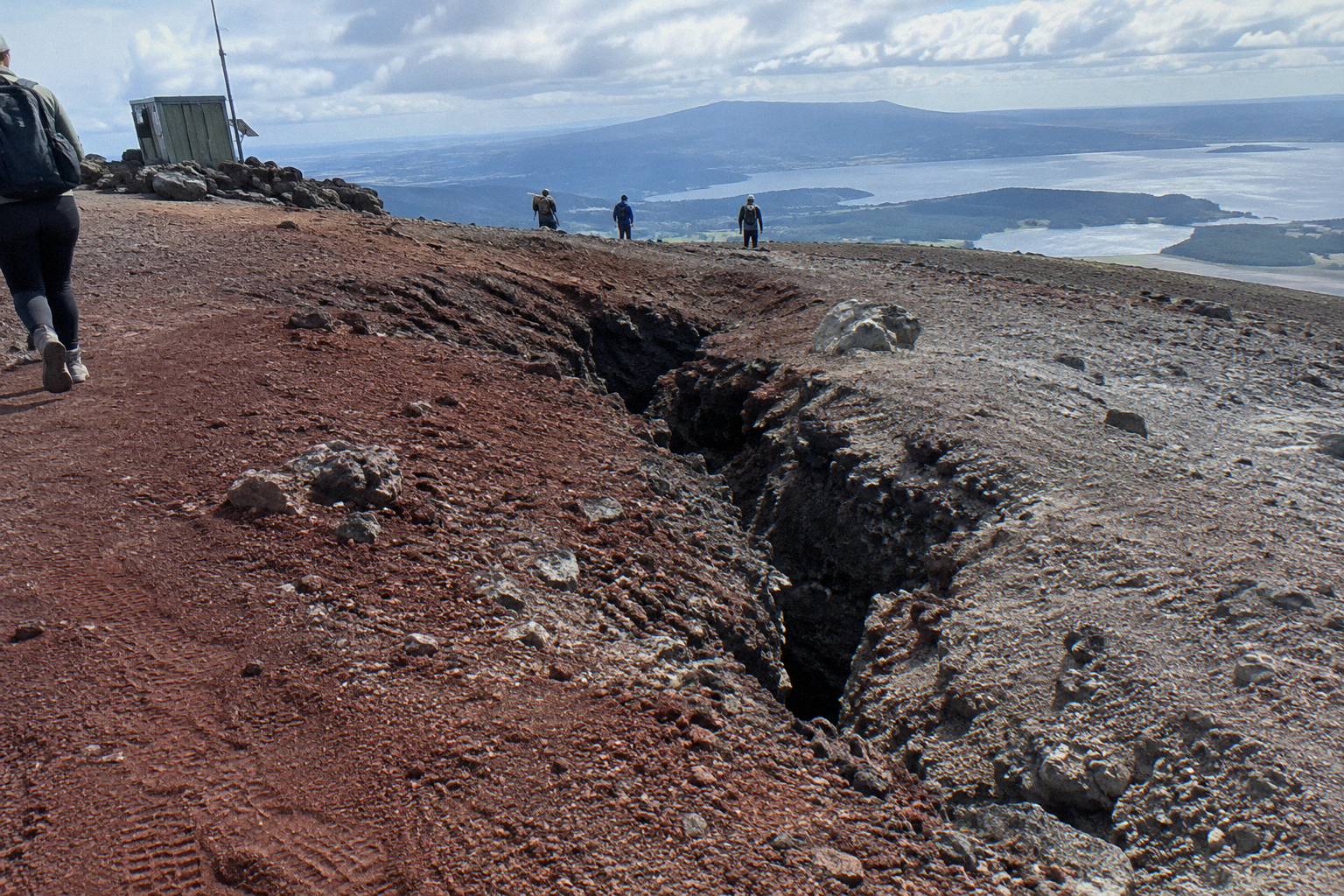
Two constraints shape every landing flight. First, access: independent summit access to Tarawera is not permitted, and Ruawahia 2B Trust governs the mountain, with Volcanic Air operating as a concessionaire alongside Ngati Rangitihi, so a guided flight or walk is the only legal way onto the top. Second, discretion: the operator's terms state plainly that excursion landings are undertaken at your own risk and at the pilot's sole discretion, with tour duration, flight times and inclusions varying due to weather conditions, volcanic activity and passenger loadings. A landing is never a promise; it is a plan the pilot confirms in the air.
| Landing flight | Total time | What makes it different |
|---|---|---|
| Helicopter Landing, Guided Summit Walk | 40 minutes | The compact version, summit walk included, from NZ$675 per person |
| Helicopter Volcano Landing | Tarawera flight | Rated 4.9 across 43 reviews, the straightforward landing tour |
| One-Hour Volcanic Adventure | About one hour | More air time around the volcanic zone, maximum 6 travellers |
| Volcanic Extremes, 1h45m | 1 hour 45 minutes | Adds a Whakaari flyover to the Tarawera landing |
| Geothermal Park Landing, 3 Hours | 3 hours | Tarawera summit plus Orakei Korako, from NZ$1,490 per person |
For the full story of the mountain, the access rules and what the summit walk covers, see the Mt Tarawera helicopter landing guide.
The One-Hour Volcanic Adventure suits a specific buyer: the flyer who found the 40-minute version too short and the three-hour expedition too much day. It carries a maximum of 6 travellers and a 110 kg per-passenger weight figure on its booking page, and it keeps the summit landing at the centre while stretching the airborne sightseeing around it.
What You Fly Over: Lakes, Craters And The 1886 Rift
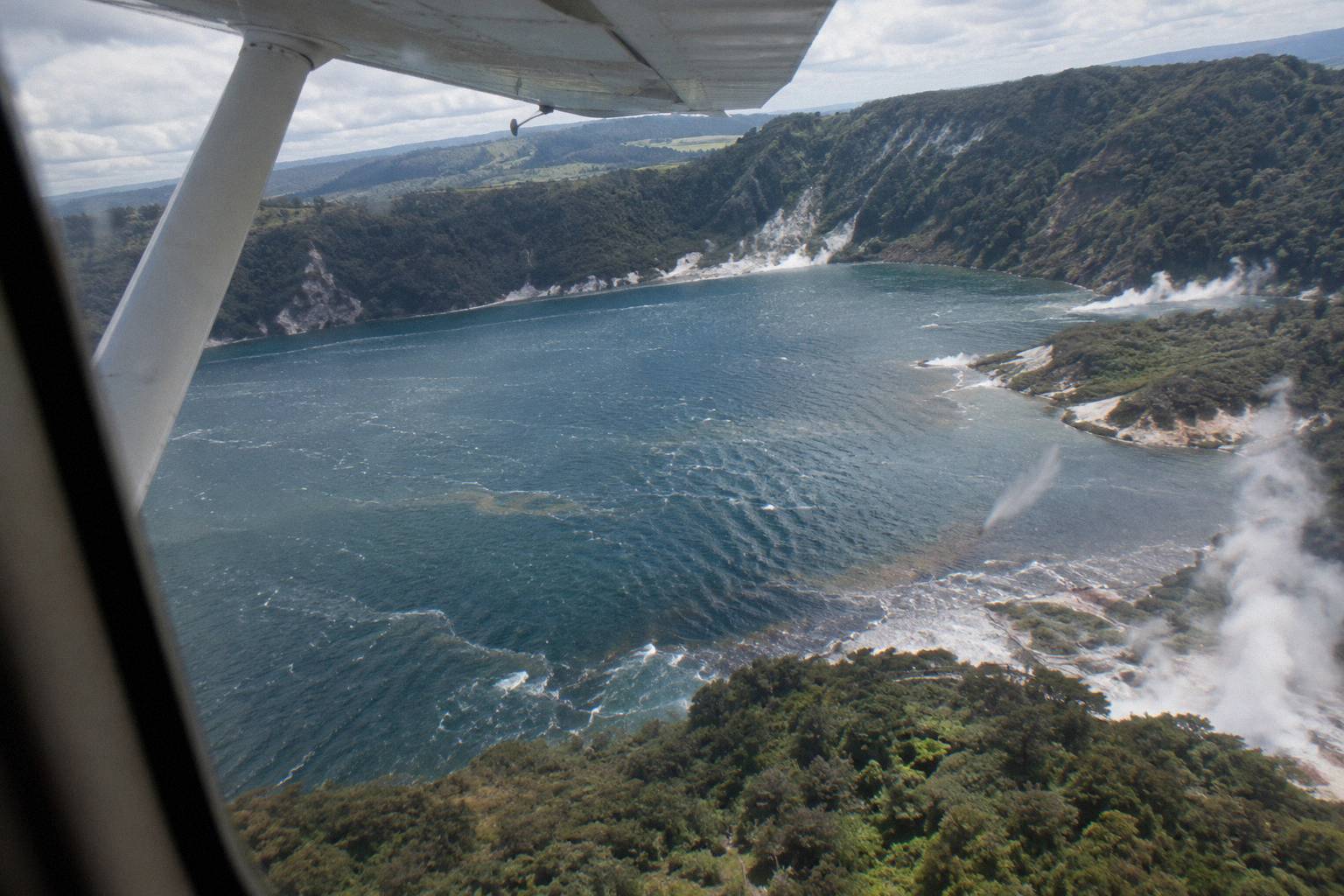
The standard Rotorua view from the air strings together the crater lakes: Rotoiti, Okataina, Tarawera, Okareka, Rotomahana, Rotokakahi (Green Lake) and Tikitapu (Blue Lake), with Mokoia Island, Sulphur Bay and the city on the climb-out, and the Tarawera flights crossing Okareka, Okataina and Tarawera on the way to the volcano. The landscape below is the direct product of one night, 10 June 1886.
That night, Mt Tarawera erupted. The GNS fact sheet records a rift tearing 17 km across the mountain top, through Lake Rotomahana and into the Waimangu Valley area, killing more than 100 people in villages near the mountain and burying the famous silica hot springs known as the Pink and White Terraces. Te Wairoa village was razed and all but covered with ash and mud; it is known today as The Buried Village. The full historical account, with sources, sits in the 1886 eruption from above guide, and NZ History's eruption page records the event in detail.
Every long ride overflies pieces of that night. Waimangu Volcanic Valley, about 25 minutes drive from the city centre at 587 Waimangu Road, exists because the 1886 rift opened into it, and its geothermal system is, on the valley's own account, the result of the eruption. Lake Rotomahana grew to a multiple of its former size, though sources disagree on the multiple. The crater lakes flights wrap the whole lake district into 15 minutes; the Tarawera flights fly the rift line directly. The full index of guides sits on Rotorua Helicopter Tours.
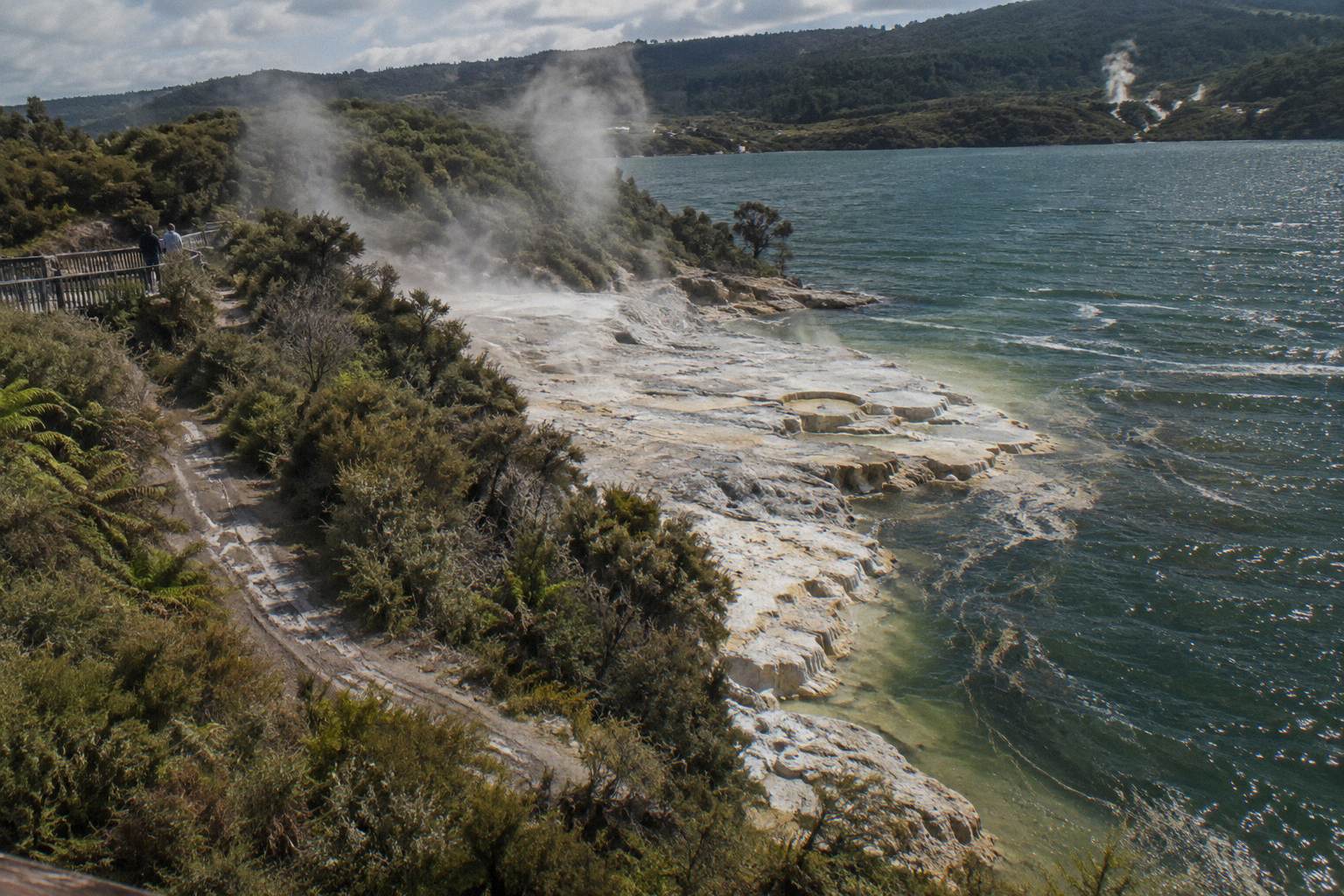
The geothermal parks add a second layer. Orakei Korako sits on the Waikato River at Lake Ohakuri between Taupo and Rotorua, and its geothermal field is accessible only by boat, a short ferry ride across the lake from the visitor centre, with boats leaving on request rather than a timetable. The floatplane landing flight solves that access problem by landing on the river itself. The park claims, in its own wording, up to 23 active geysers and Ruatapu Cave, over 36 m deep, leading down to the Pool of Mirrors; those are park claims, stated as such.
Practical Rules: Weight, Children And Cancellation
Weight must be declared at booking and passengers are weighed on arrival, because the aircraft must stay within balance limits; over 110 kg a surcharge may apply at the operator's sole discretion, and over 135 kg as weighed requires two adult fares. Children of all ages are welcome, under 2 fly on a lap, and ages 2 to 11 pay child rates. Every flight carries free cancellation up to 24 hours before departure.
The weight rules are the ones that surprise people, so they are worth the detail. The operator's terms and conditions, clause 1.16, state that any deviation from your declared weight may result in a flight being rescheduled, a surcharge being applied, or a booking being cancelled, at the operator's sole discretion. This is not fine print aimed at anyone; it is physics. A helicopter's balance shifts with every passenger, and the weigh-in on arrival keeps the load legal and the flight safe.
| Rule | What applies |
|---|---|
| Weight declaration | Individual weights provided at booking, weighed on arrival |
| Over 110 kg | Surcharge may apply, at the operator's sole discretion |
| Over 135 kg as weighed | Two adult fares required |
| Children | All ages welcome; under 2 on a lap; child rates 2 to 11 |
| Tarawera landing flights | Minimum 2 adult fares; ages 2 to 11 pay 75% of the adult fare |
| Weather cancellation | Operator reschedules or gives a full refund |
| Guest cancellation | Free up to 24 hours before departure, every flight |
Pregnancy and mobility are not automatic barriers, on the operator's FAQ: both depend on the individual situation and the flight, and the operator asks to be told at booking so assistance can be agreed in advance. The FAQ's specific advice on pregnancy is to talk to a maternity carer, especially from 28 weeks, and to contact the operator with a due date.
Cancellation splits into two directions. If the operator cancels before the flight for circumstances beyond its control, weather or volcanic activity, the terms provide a full refund. If you cancel, the 24-hour free-cancellation terms on the booking pages apply, which is the version given above rather than the operator's own fee ladder for direct bookings. The deeper workings, including what happens on a weather call, sit in what happens if a flight is cancelled for weather.
When To Fly And What The Weather Does
Flights operate all year during daylight hours, and there is no single best time, because the operator's own answer is that it depends on the day's weather: mornings often give the calmest conditions and smoothest flying with soft photo light, while afternoons can bring warmer temperatures and late-day colour, especially in winter. The driest window statistically is late spring to early autumn, October to April.
The rainfall record backs that up. Rotorua's monthly rainfall, on 1991 to 2020 normals charted from NIWA data, runs from 86.8 mm in November and 92.9 mm in October up to 137.4 mm in July, with the winter months of May through August all among the heaviest of the year. That does not mean winter flights are a poor bet; it means winter bookings deserve a flexible schedule, because a front can close the mountain for a morning and reopen it after lunch. Rotorua NZ's own note names the October to April window as the driest and warmest.
| Season | Rainfall pattern | Flight planning angle |
|---|---|---|
| Late spring, October to November | Lightest months, 92.9 and 86.8 mm | Long expeditions and photography flights |
| Summer, December to February | Moderate, 117.1 to 100.4 mm | Peak season, book ahead |
| Autumn, March to April | Rising, 100.3 then 133.0 mm | Warm air, late-day colour |
| Winter, May to August | Heaviest, 125.2 to 137.4 mm | Calm mornings between fronts, quieter skies |
One planning habit serves every season: book the flight early in your stay, not on your last day. If weather moves the flight, the operator works with you to reschedule, and an early slot leaves room for that. The booking pages' own wording on the scenic Tarawera and Waimangu flight is blunt: it is weather dependent, it will not go ahead if it is not safe to do so, or if the views cannot be seen.
Mistakes To Avoid When Booking A Rotorua Helicopter Ride
The common booking mistakes are concrete: expecting a guaranteed Tarawera landing when it sits at the pilot's sole discretion, booking a floatplane Tarawera flight expecting a summit touchdown when every floatplane Tarawera ride is a flyover, assuming hotel pickup is included when standard flights require your own way to the Lakefront, declaring an optimistic weight when the arrival weigh-in can reschedule or cancel the booking, and squeezing the flight onto the final day with no room to reschedule.
Each of these has a fix, and none costs money. Read the landing column of the flight menu before the duration column, and the aircraft type before both. Ring-fence a morning early in the trip. Declare weight accurately and mention pregnancy, mobility or children at booking rather than at check-in, when there is no time to arrange anything. And treat the free 24-hour cancellation as the safety net it is: a booking made early holds the seat, and the terms let you adjust without penalty if plans shift.
The subtler trap is comparing rides on price alone. The three rides in the selection band below cover three genuinely different products: a summit landing, a value flyover and a landing with a guided walk. A 15-minute lake hop and a three-hour dual-landing expedition are not the same purchase at different prices; they answer different questions about what a flight over Rotorua is for.
Common Questions About Booking A Flight Over Rotorua
Where Does A Helicopter Ride In Rotorua Depart From?
Every flight on the line-up departs from the Lakefront base at 1 Lakefront Drive, Rotorua 3010, under 1 km from the town centre. Helicopters check in 30 minutes before departure and floatplanes 20 minutes before, both at the Lakefront office for a full safety briefing. Floatplanes then take off from Lake Rotorua at the lakefront pier.
Can A Helicopter Land On Mt Tarawera?
Yes, several helicopter flights land on the summit, but a landing is never guaranteed. The operator's terms state that excursion landings are undertaken at your own risk and at the pilot's sole discretion, with duration and inclusions varying due to weather, volcanic activity and passenger loadings. Independent summit access is not permitted, so a guided flight or walk is the only access.
How Much Does A Helicopter Ride In Rotorua Cost?
From-prices on the line-up include NZ$395 per person for the scenic floatplane over Tarawera and Waimangu, NZ$675 per person for the Tarawera helicopter landing with guided summit walk, and NZ$1,490 per person for the three-hour geothermal park landing expedition. Amounts are New Zealand dollars, per person, and every flight carries free cancellation up to 24 hours before departure.
Is A Floatplane Or A Helicopter Better For Seeing Rotorua?
It depends entirely on the landing. Only helicopters land on the Tarawera summit; every floatplane Tarawera flight is a flyover. Floatplanes land on water, which makes the Orakei Korako river landing their signature, and both aircraft run a 15-minute crater lakes version for a pure aircraft comparison. Pick the landing first, and the aircraft follows.
Do I Need To Be Weighed Before A Rotorua Helicopter Flight?
Yes. Individual weights are declared at booking and passengers are weighed on arrival so the aircraft stays within balance limits. Over 110 kg a surcharge may apply at the operator's sole discretion, and over 135 kg as weighed requires two adult fares. A declared weight that turns out wrong can mean a reschedule, a surcharge or a cancelled booking.
What Happens If The Weather Cancels My Flight?
The operator's terms provide a full refund if it cancels before the flight for circumstances beyond its control, including weather and volcanic activity, and the FAQ says the operator will work with you to reschedule or refund. This is separate from the 24-hour free cancellation that applies to your own changes on every flight booking.