Private Helicopter Charter In Rotorua: Who It Suits
Volcanic Air flies shared-seat helicopters and floatplanes from the Rotorua Lakefront, and handles bespoke charters by direct conversation, with direct hotel pick-ups offered only for those charters.
Short answer
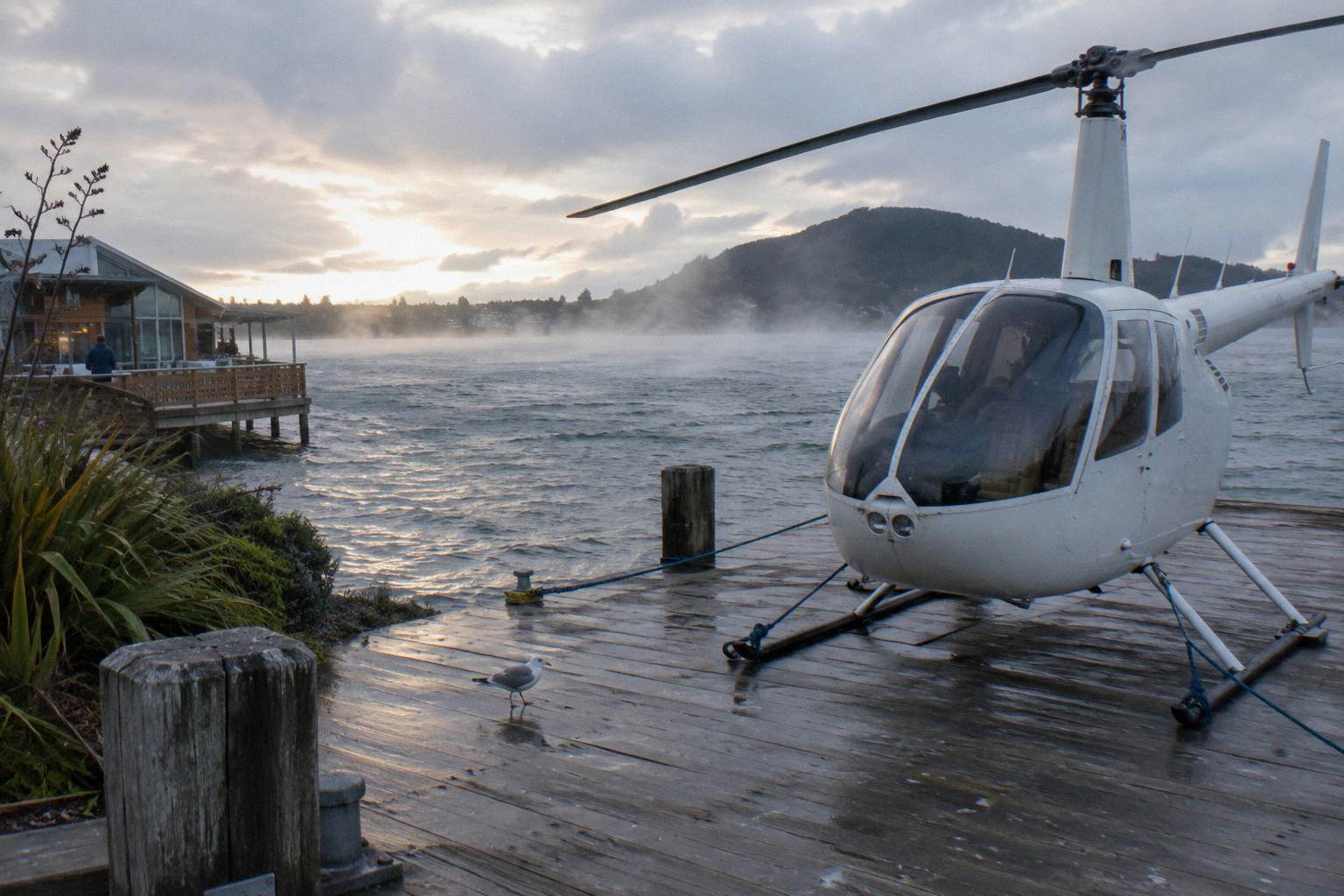
A private helicopter charter in Rotorua is arranged by talking with Volcanic Air directly rather than booking a seat on a scheduled flight. The operator's FAQ confirms bespoke charters exist and that direct pick-ups apply only to them. No bookable private product sits on the line-up and no charter price is published, so the comparison starts with the shared flights.
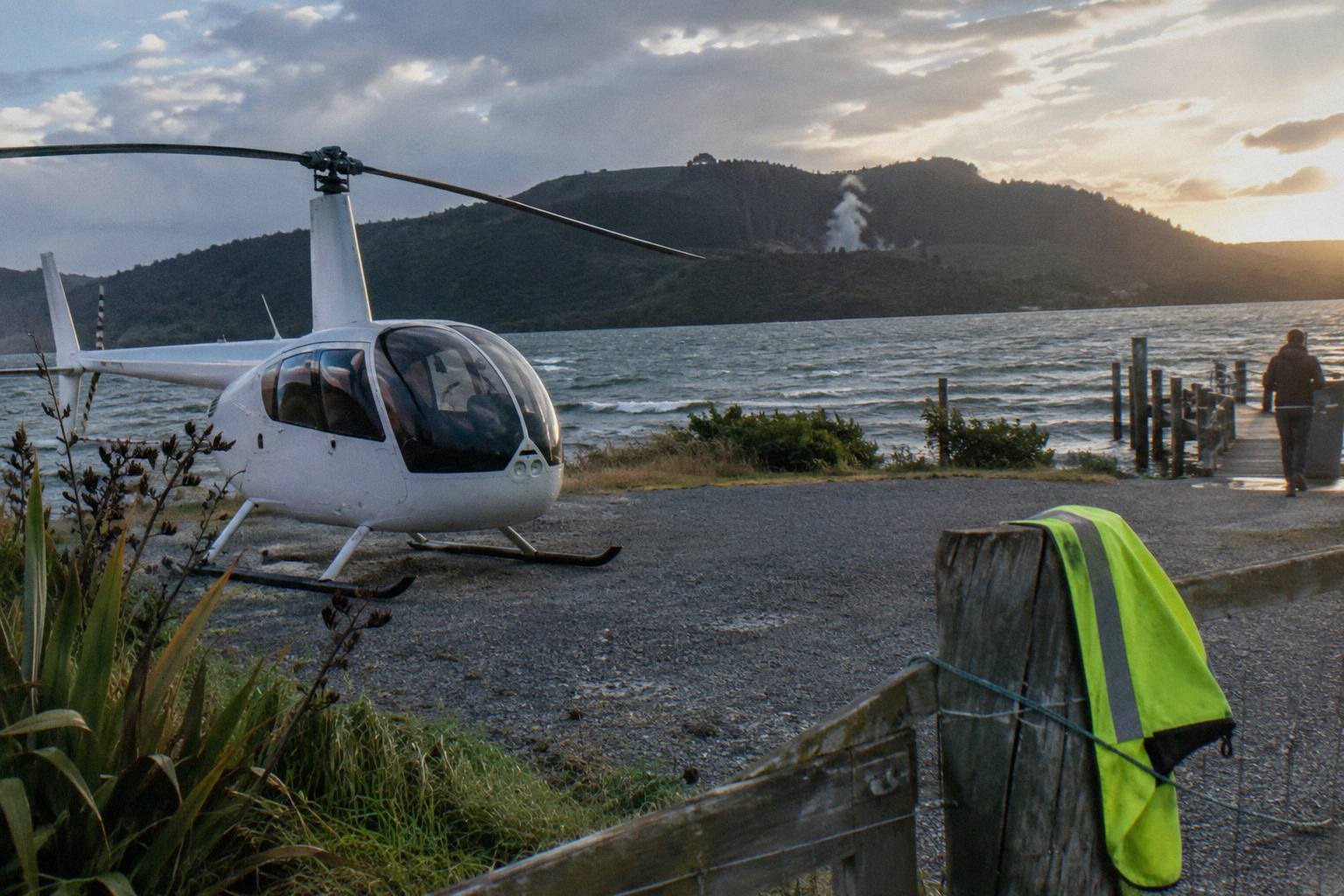
That is the shape of the decision, and it is a genuinely useful one. For more on the operator itself, see the Rotorua Helicopter Tours hub, which covers every flight in the region from one base.
Quick Facts
| Question | Answer |
|---|---|
| Who runs charters? | Volcanic Air, from the Rotorua City Lakefront, 1 Lakefront Drive |
| Since when? | Flying in the region since 1992, operator wording |
| How is a charter booked? | Direct conversation with the operator, not a scheduled-seat booking |
| Direct pick-ups? | Offered only for bespoke charters, per the operator FAQ |
| Published charter price? | No published price; no bookable private product sits on the line-up |
| Shared-flight anchor prices | From NZ$395 to NZ$1,490 per person depending on the trip |
| Check-in for shared flights | 30 minutes prior for helicopters, 20 for floatplanes |
What A Private Helicopter Charter In Rotorua Actually Gets You
A private charter buys the whole aircraft, a route shaped in conversation with the operator, and the one perk no shared flight offers: direct pick-up. The operator's FAQ is explicit that hotel pickup is not part of standard flights and that direct pick-ups are offered only for bespoke charters. Beyond that single confirmed difference, everything else, the aircraft, the pilots, the Lakefront base, is the same operation that flies the shared line-up every day of the year.
The scope gap deserves one plain sentence and then no more padding: no bookable private product sits on the current line-up, and no charter price is published anywhere the research reached. So a reader cannot compare a charter quote against a shared flight on this page, because the charter side of that comparison only exists once the operator replies to an enquiry. What a reader can do, and what the rest of this page does, is work out whether the charter conversation is worth having at all before picking up the phone.
What the conversation can cover is broad. Charters are the operator's route to itineraries that do not fit a scheduled departure: a longer Tarawera circuit, a multi-stop day pairing a summit landing with time at a geothermal park, a photography flight timed around light rather than a timetable. The pilots named on the operator's About page bring serious hours, including one with more than 18,000 and another with more than 5,000, all operator-stated figures. The operator describes itself as a CAA-certified NZ air operator, and Civil Aviation Rule Part 135 governs air operations in helicopters and small aeroplanes, which is the regulatory frame every flight, shared or chartered, sits inside.
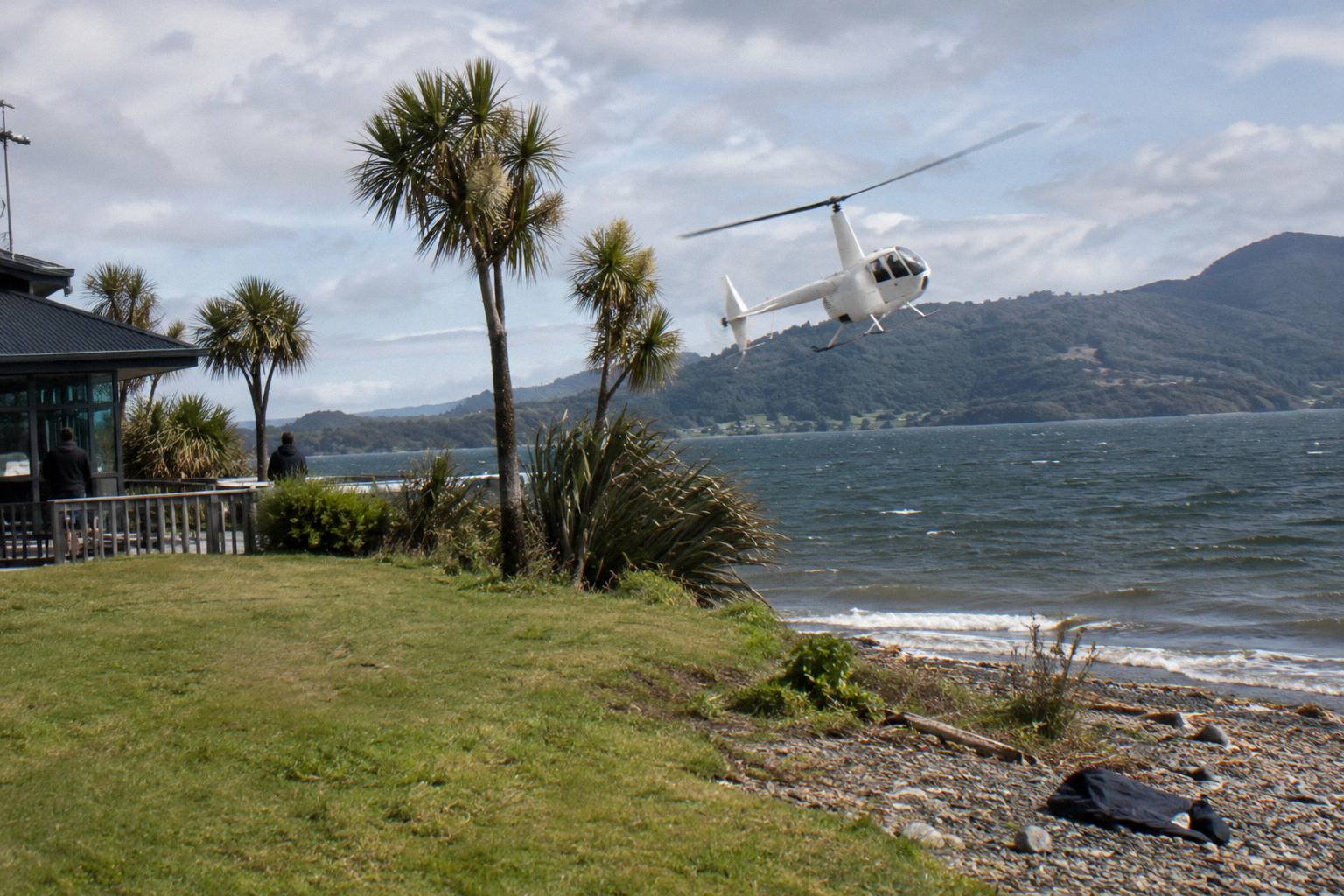
The base matters more for charters than it first appears. Both helicopters and floatplanes leave from the Lakefront, under 1 km from the Rotorua centre, and floatplanes take off from Lake Rotorua itself off the lakefront pier. A charter group arriving together checks in at the same office, gets the same full safety briefing, and boards from the same pad. The difference is who else is, or is not, already seated.
How A Charter Compares With The Shared Flights On Offer
The thirteen bookable flights split into four shapes: short crater-lakes loops of 15 minutes, Tarawera landing flights of roughly 40 minutes to an hour, twin-landing explorers of three hours, and floatplane flyovers including Whakaari. Chartering matters most when a group wants to combine shapes, control timing, or fill an aircraft that shared seats would leave half empty. For a single couple wanting one classic experience, a shared flight is almost always the simpler call.
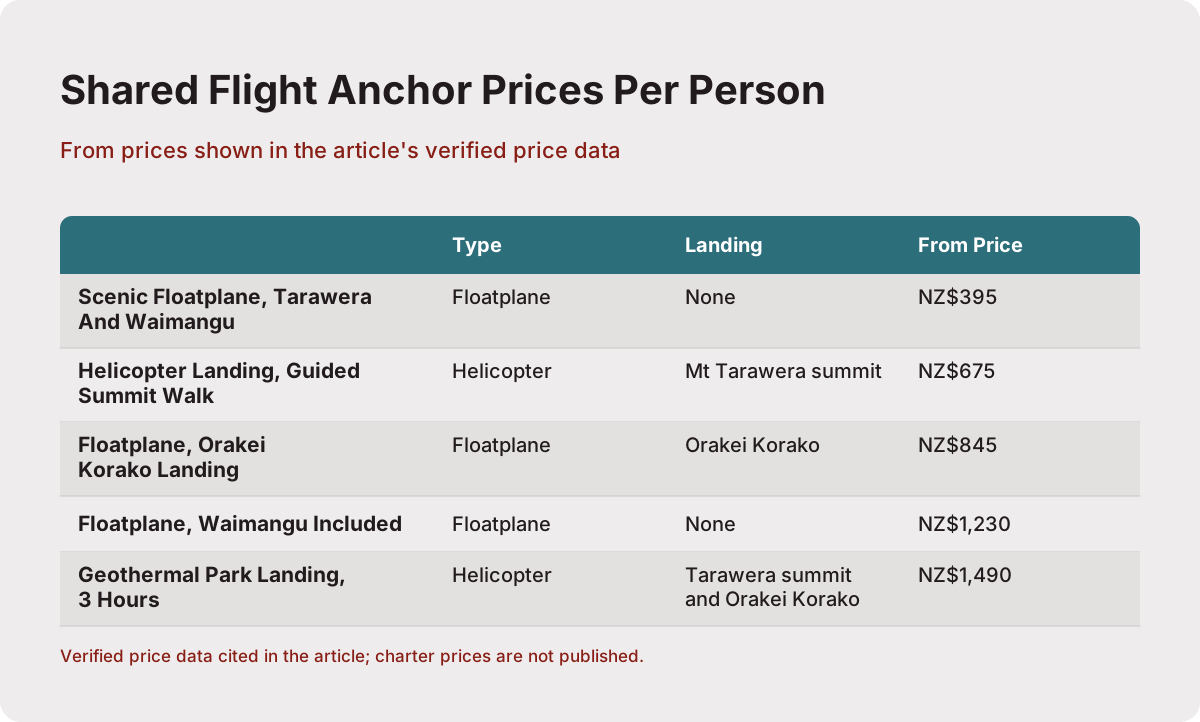
The price logic explains why. Shared flights sell seats, so two people on the Helicopter Volcano Landing pay two fares, while a charter pays for the aircraft and pilot regardless of how many seats are filled. The larger the group, the more the arithmetic shifts toward the charter conversation, and the smaller the group, the more the from-prices below do the deciding. All amounts are New Zealand dollars.
| Flight (short name) | Type | Landing | From price per person |
|---|---|---|---|
| Scenic Floatplane, Tarawera And Waimangu | Floatplane | No landing (flyover) | NZ$395 |
| Helicopter Landing, Guided Summit Walk | Helicopter | Mt Tarawera summit | NZ$675 |
| Floatplane, Orakei Korako Landing | Floatplane | Orakei Korako | NZ$845 |
| Floatplane, Waimangu Included | Floatplane | No landing (flyover) | NZ$1,230 |
| Geothermal Park Landing, 3 Hours | Helicopter | Tarawera summit and Orakei Korako | NZ$1,490 |
The 15-minute crater-lakes flights and several others print no from-price in the verified price data, so no figure is shown for them here; the price appears on each booking page. Ratings follow the same discipline: the Helicopter Volcano Landing carries 4.9 from 43 reviews and the Scenic Floatplane 4.9 from 28, while the rest of the line-up has review pools too small to print a meaningful star figure beside.
For readers whose interest is the premium end of the shared line-up, these three come closest to what charter enquiries usually ask for: twin landings, long air time, and the volcanic extremes circuit.
The Geothermal Park Landing packs a Tarawera summit landing and Orakei Korako into a three-hour helicopter day, the Dual Landing Thermal Explorer covers the same two landing stops in a different configuration, and the Volcanic Extremes helicopter pairs a Tarawera landing with a Whakaari flyover across 1 hour 45 minutes of flying. A group of four or five comparing those three against one charter quote is doing exactly the right maths.
Who Should Have The Charter Conversation
Groups of five or six, proposal and anniversary planners, photographers with specific light requirements, and anyone needing direct pick-up should call the operator directly. Couples and trios after a single classic experience should book shared seats instead. The operator's FAQ notes a maximum of six travellers on flights such as the One-Hour Volcanic Adventure, which hints at typical cabin size and therefore at the group size where chartering the whole aircraft starts to make sense.
The proposal case is the clearest. A shared flight means strangers, a fixed departure window, and a walk timed to a schedule; a charter means the aircraft, the timing, and the privacy can all be shaped around one question. The same logic applies to milestone birthdays and family reunions where the flight is the event rather than the transport. There is a dedicated page on planning a proposal by helicopter in Rotorua that works through the details.
Photographers sit in a second bucket. The operator's FAQ describes mornings as often giving the calmest weather and smoothest flying with soft light, and afternoon flights as offering warmer temperatures and late-day colour, especially in winter. A shared flight departs when it departs; a charter can chase a specific window, weather permitting, and the operator reschedules or fully refunds when weather grounds a flight.
Families fit a third. All ages are welcome, children under 2 sit on a lap, and child rates apply from 2 to 11, with the Tarawera landing flight charging ages 2 to 11 at 75% of the adult fare and requiring a minimum of two adult fares. A family filling most of a cabin may find the charter quote competitive with six shared fares, though no charter price can be confirmed here. The family guide to Rotorua helicopter flights unpacks the age rules trip by trip.
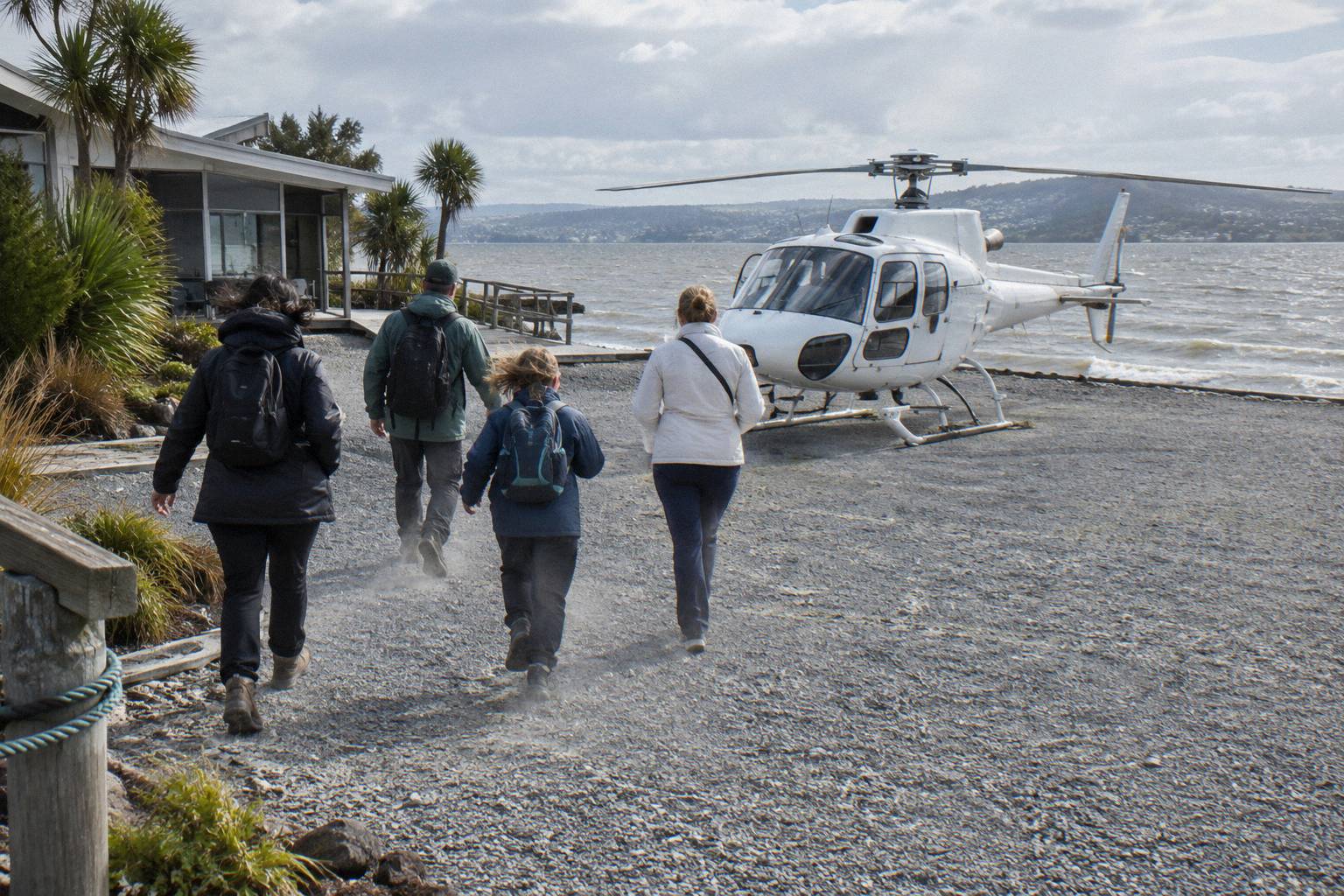
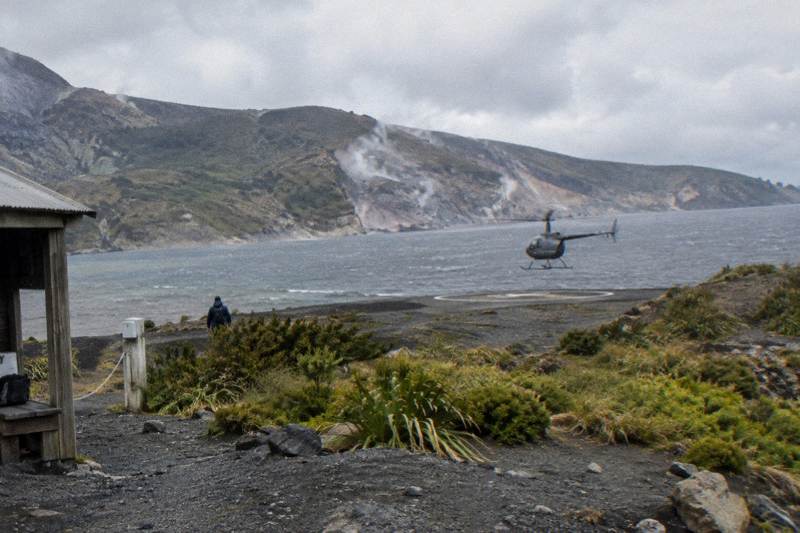
For everyone who lands on the shared-seat side of that split, the Helicopter Volcano Landing is the flight charter enquiries most often turn out to be describing: a Tarawera summit landing with a guided walk, bookable by the seat.
One caution belongs here because it decides whole charter itineraries: a Tarawera landing is never guaranteed. The operator's own wording is that excursion landings are undertaken at your own risk and at your pilot's sole discretion, with duration and inclusions varying with weather, volcanic activity and passenger loadings. Any charter conversation should ask what the fallback route is if the summit is out, and the Tarawera landing guide covers how that discretion works in practice.
How Charter Weight And Seating Rules Work
Weight rules are identical for charter and shared flights, and they are strict. Every passenger declares an individual weight at booking and is weighed on arrival, because seating must keep the aircraft within balance limits. Declared weights that deviate can mean a rescheduled flight, a surcharge, or a cancelled booking at the operator's sole discretion, and anyone over 135 kg as weighed requires two adult fares.
The full ladder sits in the operator's terms, which apply to every flight from the Lakefront regardless of how it was arranged. The key numbers for a group planning a charter conversation are in the table below; they also apply seat by seat on the shared line-up.
| Weight or age rule | What applies |
|---|---|
| Declared weight at booking | Required for every guest, individually |
| Weigh-in | On arrival, before boarding |
| Over 110 kg | A surcharge may apply, operator's sole discretion |
| Over 135 kg as weighed | Two adult fares required |
| Children under 2 | Sit on a parent or guardian's lap |
| Ages 2 to 11 | Child rates; 75% of adult fare on the Tarawera landing flight |
The operator's terms and conditions carry the exact clauses, and the operator FAQ explains the weigh-in in plainer language. The practical charter angle is that a private group controls its own manifest: no strangers' weights shifting the balance calculation, but also no hiding from it, since every passenger is weighed regardless. Groups should collect accurate weights before enquiring, because an aircraft load that cannot be balanced is a route that cannot be flown no matter who booked the seats.
Pregnancy and mobility are handled by conversation rather than blanket bans. The FAQ notes pregnancy is not automatically a barrier, depends on weeks and the flight involved, and suggests talking to a maternity carer especially from 28 weeks, and that mobility needs should be flagged at booking so boarding assistance can be agreed in advance. Both points belong in a charter enquiry from the start rather than on the day.
What A Charter Route Could Include
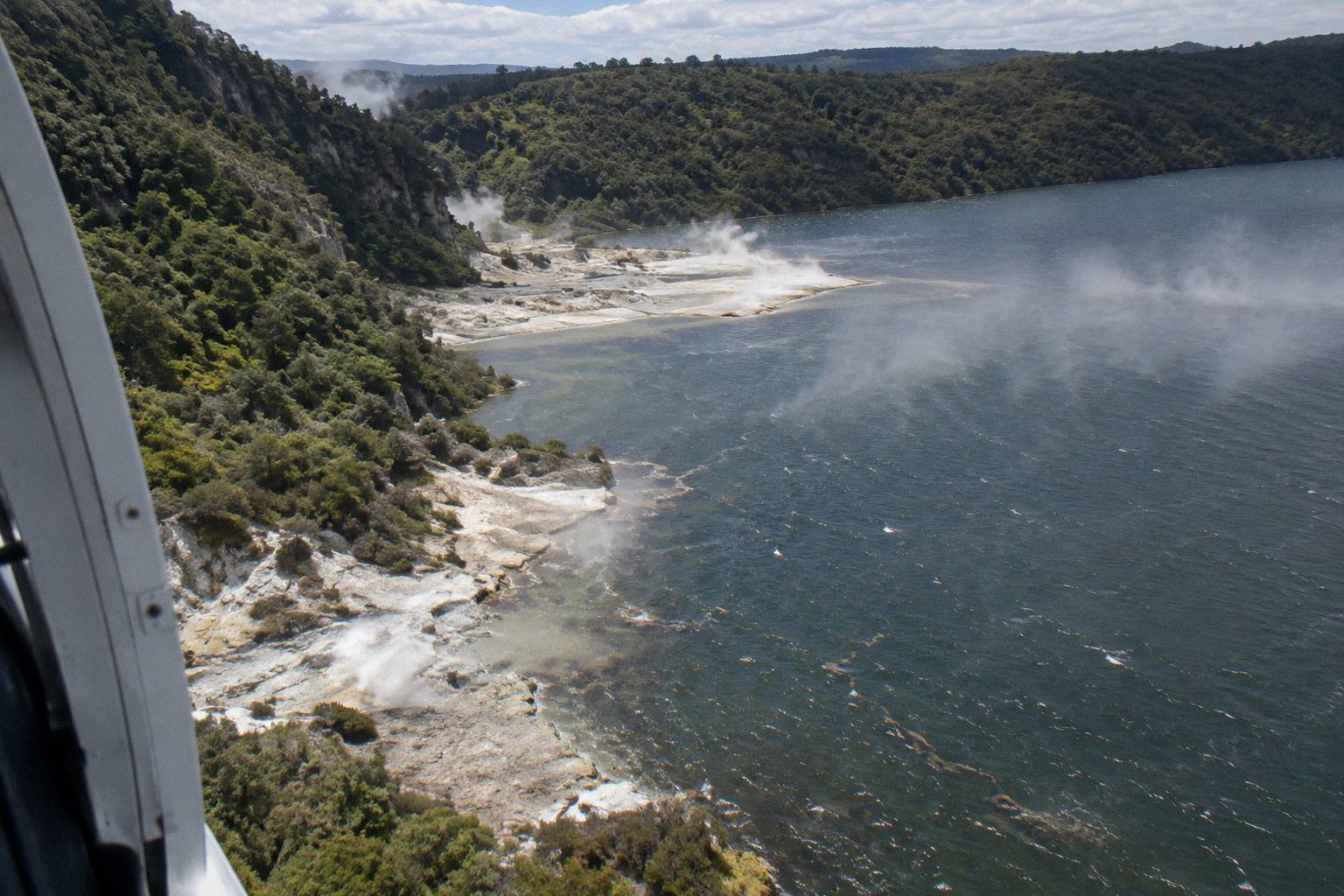
Every bookable flight's route is a candidate charter leg: the crater-lakes loop over up to 12 lakes, the Tarawera rift crossing Okareka, Okataina and Tarawera, the southern run past Waimangu to Orakei Korako on the Waikato River, and the long Whakaari circuit about 48 km off the Whakatane coast. A charter simply chains these legs or lingers on them, always weather permitting and always at the pilot's discretion on landings.
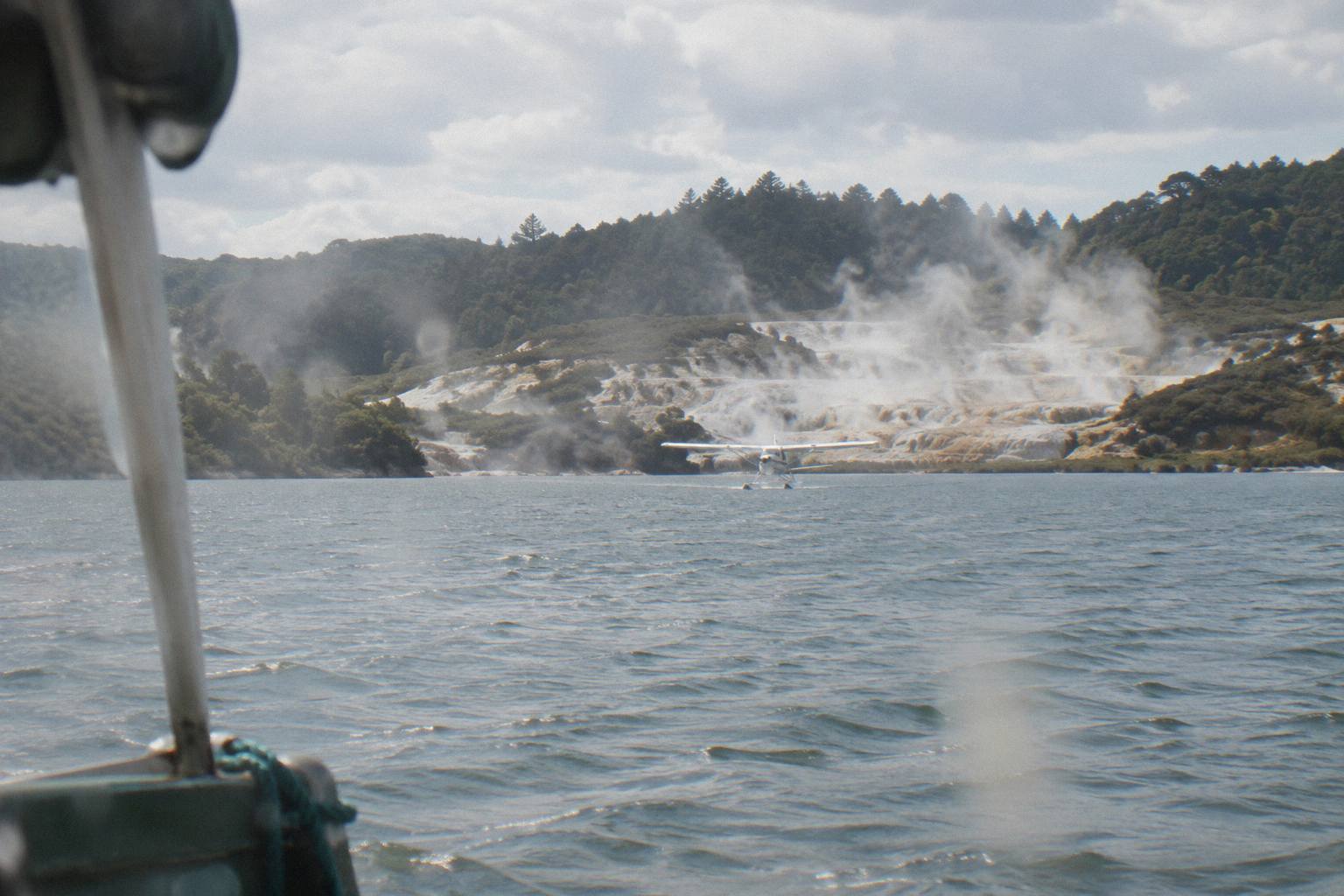
The geography rewards the chaining. Tarawera's summit stands 1,111 m above lakes that sit close enough together that a 15-minute shared flight can show a visitor seven of them by name: Rotoiti, Okataina, Tarawera, Okareka, Rotomahana, Rotokakahi and Tikitapu. Further south, Waimangu Volcanic Valley sits about 25 minutes' drive from the city centre, formed along the rift opened on the night of 10 June 1886, and beyond it Orakei Korako's geothermal field is reached only by boat across Lake Ohakuri, which is exactly why the floatplane landing there works: the pilot touches down on the winding Waikato River.
History gives a charter route its narrative spine. The 1886 eruption tore a rift GNS measures at 17 km across the mountain top, through Lake Rotomahana and into the Waimangu area, killed more than 100 people in villages near the mountain, and buried the Pink and White Terraces; the NZ History account of the Tarawera eruption and the Te Ara record of historic volcanic activity both cover it. The operator's own flight wording describes 8 km of rift over the mountain, a different span of the same event, and a charter conversation can ask the pilot to trace whichever reading the group wants to follow. The guide to the 1886 eruption from above maps what is visible from the air.
Whakaari changes the calculus. Landings there are suspended; official tourism guidance states there are currently no boat tours to the island and no helicopter flights landing on it, so flyover only is the reality, and live status sits with GeoNet rather than on any tour page. A charter cannot buy a Whakaari landing, and any enquiry should treat the island as a flyover leg at most.
For groups wanting a preview of the mid-length shared options before shaping a charter route, two flights bracket the space nicely.
The Helicopter Landing, Guided Summit Walk packs a Tarawera crossing, a summit landing and a 15-minute guided walk into about 40 minutes total, from NZ$675 per person. It is the shortest route to standing on the mountain, and a good benchmark for what a charter would need to beat on time alone.
Cancellation, Weather And The Charter Conversation
Every flight, chartered or shared, operates subject to suitable weather and safe flying conditions. If weather stops a flight the operator works to reschedule or fully refunds, and operator cancellations for circumstances beyond its control, including weather and volcanic activity, carry a full refund. Booked by seat on the standard line-up, every trip carries free cancellation up to 24 hours in advance for a full refund. Charter terms are whatever the direct conversation agrees.
That last sentence is the whole reason to have the conversation in writing. The 24 hour free-cancellation terms belong to the bookable shared flights; a bespoke charter negotiated directly sits outside them unless the operator says otherwise, and a group spending charter-level money should ask specifically what happens if illness, weather or a changed plan kills the date. The weather-cancellation explainer walks through the shared-flight side.
Seasonality shapes when to enquire. The driest, warmest Rotorua weather runs from late spring in October to early autumn in April, per Rotorua's official tourism FAQ, though the operator flies all twelve months in daylight hours. Winter charters trade cooler mornings for late-day colour and easier availability; the rainfall table below shows why autumn and midwinter dates carry more reschedule risk.
| Month | Average rainfall, mm |
|---|---|
| January | 93.8 |
| March | 100.3 |
| May | 130.2 |
| July | 137.4 |
| September | 106.6 |
| November | 86.8 |
Timing within the day matters as much as the month. Mornings often bring the calmest air and smoothest flying, afternoons warmer temperatures and low light, and the operator holds no fixed answer on which is better because it depends on the day. A charter group can hedge by holding two windows, something a shared booking cannot do; the best-time-of-day guide compares the options. Bookings crowd in the October to April window, so the how-far-ahead-to-book post is worth a read before any peak-season enquiry.
What To Ask The Operator When You Call
Ask five things: the aircraft type and passenger count for your date, whether the route you want is flyable in one block, what the landing fallback is if Tarawera is out, the cancellation and reschedule terms in writing, and whether direct pick-up applies to your group. Bring every passenger's accurate weight, ages of any children, and mobility or pregnancy details to the same call, since all of them change what can be flown safely.
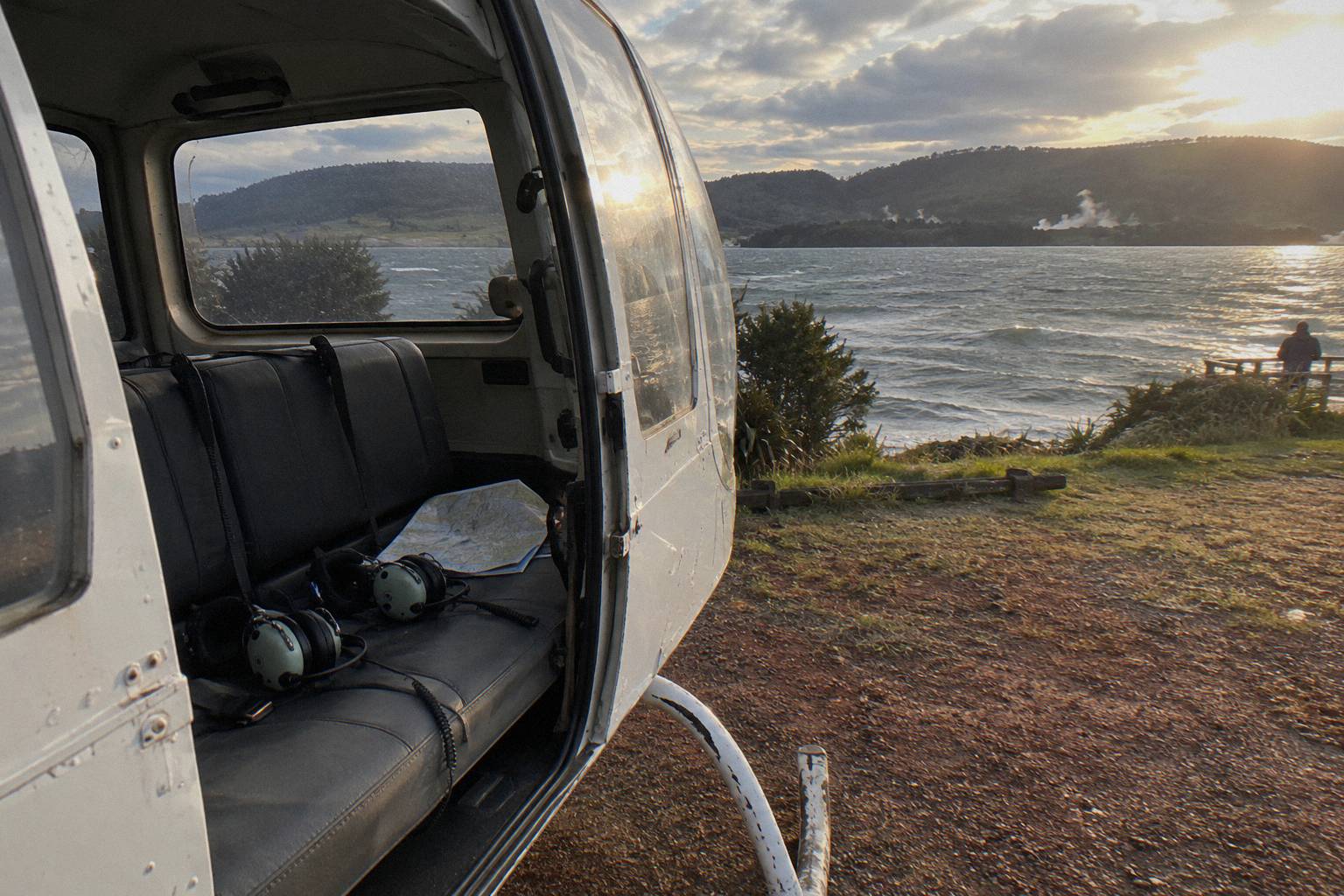
The first two questions do real work. Aircraft size sets the price ceiling, because a six-passenger machine chartered by four people wastes two fares' worth of capacity, and route feasibility depends on fuel, weather windows and daylight rather than on what looks close on a map. The Whakaari leg is the obvious example: about 48 km off the Whakatane coast each way, it turns a scenic loop into a serious cross-country flight, which is why the shared Volcanic Extremes helicopter spends 1 hour 45 minutes airborne to include it.
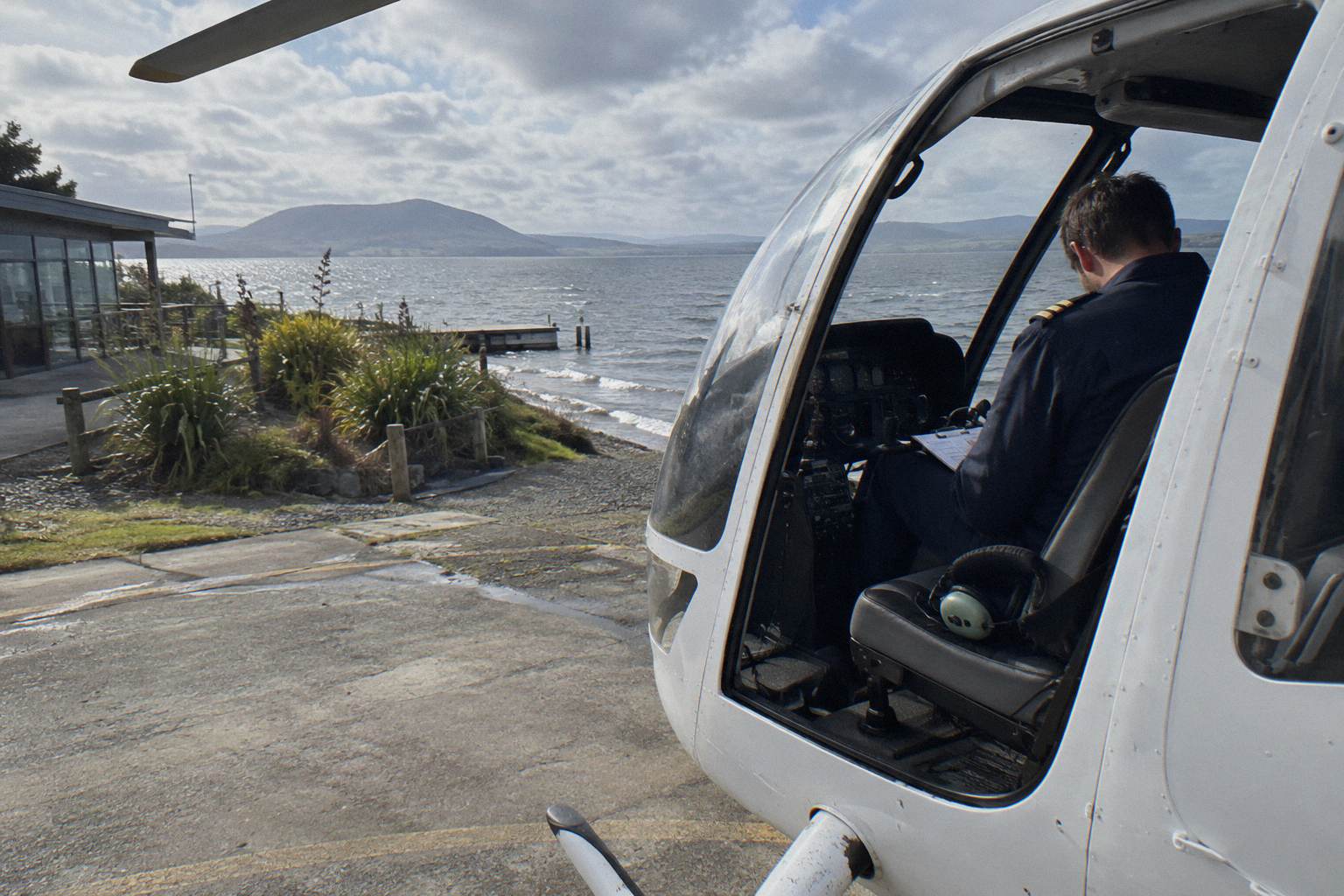
The fallback question matters because landings are discretionary. If the pilot alone decides whether the summit landing happens, a charter group should know beforehand whether the alternative is a longer flyover, a different landing, or a shortened route with an adjusted cost. The operator's terms also flag the hazards plainly: flights land and take off on hard terrain or water, and natural hazards include earthquakes, geothermal activity, landslides and fast changing weather.
What to bring barely changes between charter and shared flights: camera, sunglasses, a jacket, and closed-toe comfortable footwear on any flight with a landing. The charter-only extras are the group's own timings, food or celebration plans if the operator agrees to them, and realistic expectations about photography windows. The aerial photography guide covers shooting through aircraft glass.
For a group that wants most of a charter's route without the negotiation, the One-Hour Volcanic Adventure is the longest single-purchase Tarawera helicopter flight on the line-up.
The One-Hour Volcanic Adventure gives a full hour of helicopter flying with a Tarawera summit landing and free cancellation up to 24 hours ahead. It suits groups of up to six, its stated per-passenger weight limit being 110 kg, and it prints no rating because its review pool is too small to mean anything.
Mistakes People Make When Planning A Private Charter
The recurring mistakes are assuming a charter price exists to look up, comparing it against one shared fare instead of the whole cabin's, forgetting every passenger gets weighed, building an itinerary around a Tarawera landing as if it were guaranteed, and skipping the written cancellation question. Each one is avoidable in a single well-prepared phone call, and each one regularly derails groups that arrive at the Lakefront with a plan the aircraft cannot fly.
The first mistake wastes the most time. No charter price is published, so hours spent hunting a per-hour rate are hours not spent describing the actual day wanted. The operator quotes on the aircraft, the route, the season and the load; a vague enquiry gets a vague answer. Groups should arrive at the call with dates, numbers, weights and a preferred route shape, then let the operator price what is flyable.
The second mistake is arithmetic. A charter competes against six shared fares, not one, and against the twin-landing trips specifically: the Geothermal Park Landing at from NZ$1,490 per person and the Dual Landing Thermal Explorer are the products a full-cabin charter most directly replaces. A group of two comparing a charter quote against NZ$395 floatplane seats is comparing unlike things; a group of six doing the same multiplication is doing it right.
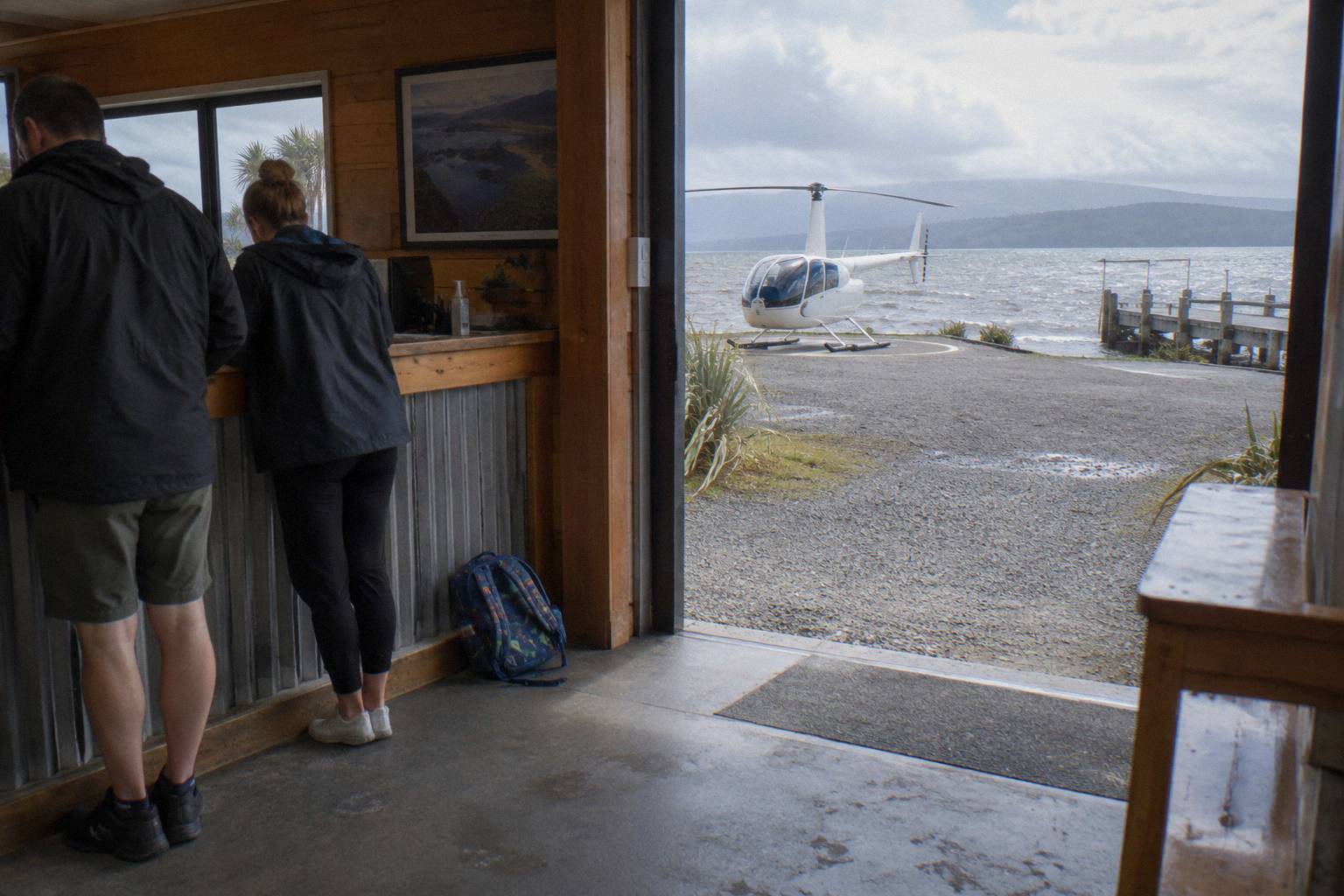
The weigh-in catches groups out every season. Weights declared lightly at booking and measured accurately on arrival can reschedule, surcharge or cancel a flight at the operator's sole discretion, and nobody wants that discovery at 30 minutes before departure, the helicopter check-in window. The third mistake, treating a landing as booked, collides with the pilot's sole discretion and with volcanic activity, which the terms list alongside weather as a reason durations and inclusions vary. The fourth, unwritten cancellation terms, is simply money unprotected. Every flight's 24 hour free cancellation exists precisely because direct bookings do not carry it automatically.
Charter Or Shared Flight: The Decision In One Paragraph
Book shared seats if your group is four or fewer, everyone wants the same named experience, and you value a from-price with 24 hour free cancellation over route control. Open a charter conversation if your group fills a cabin, needs direct pick-up, wants to chain two regions in one flight, or is staging a moment that depends on privacy and timing. Everything between those poles is a phone call, answered from the same Lakefront since 1992.
A middle path deserves a mention before the decision closes. The twin-landing and extremes flights on the line-up deliver most of what charter enquiries describe: two landing stops or a Whakaari flyover with a Tarawera landing, in one bookable purchase. The floatplane side adds options the helicopter line-up cannot match, notably a landing on the Waikato River at Orakei Korako, from NZ$845 per person. Groups hovering between charter and shared should price these before calling, because sometimes the scheduled product already is the custom day.
If the floatplane alternative appeals, the Scenic Floatplane over Tarawera and Waimangu is the gentlest and cheapest way to sample the same geography from the air.
The Scenic Floatplane gives 30 minutes of flying over Tarawera and the Waimangu Valley, 40 minutes door to door, from NZ$395 per person, rated 4.9 from 28 reviews. It lands nowhere, but it shows the rift, the lakes and the valley in the smallest commitment on the line-up, with free cancellation up to 24 hours ahead.
However the decision lands, the three flights below are the shared-seat benchmarks every charter quote should be measured against: the three-hour twin-landing day, the dual-landing explorer, and the long Whakaari-and-Tarawera helicopter circuit.
Common Questions About Private Flights
Can You Book A Private Helicopter Charter In Rotorua?
Only by direct conversation with the operator. Volcanic Air's FAQ confirms bespoke charters exist, including direct pick-ups reserved for them, but no bookable private product sits on the flight line-up and no charter price is published.
How Much Does A Private Helicopter Charter In Rotorua Cost?
No charter price is published, so no figure can be given. The comparison anchors are the shared from-prices, which run from NZ$395 per person for a 40-minute floatplane scenic flight to NZ$1,490 for the three-hour twin-landing helicopter day.
Is A Private Charter Cheaper For A Group Than Shared Seats?
It depends on cabin size and group size, and only the operator's quote can settle it. A charter pays for the aircraft regardless of filled seats, so a full cabin of five or six compares far better against shared fares than a couple does.
Does A Private Charter Include Hotel Pick-Up?
Direct pick-ups are offered only for bespoke charters, per the operator FAQ. Standard flights from the line-up do not include hotel pickup; everyone checks in at the Lakefront office, 30 minutes prior for helicopters and 20 for floatplanes.
Can A Private Charter Land On Mount Tarawera?
Approved helicopter landings on Tarawera are part of how the summit is accessed, but any landing is at the pilot's sole discretion and undertaken at your own risk, with weather and volcanic activity able to change the plan. A landing is never guaranteed on any flight.
Can A Private Charter Land On Whakaari?
No. Landings on Whakaari / White Island are suspended, with official guidance stating no boat tours or helicopter flights currently land on the island. Flyover flights operate, and live volcanic status is tracked by GeoNet.