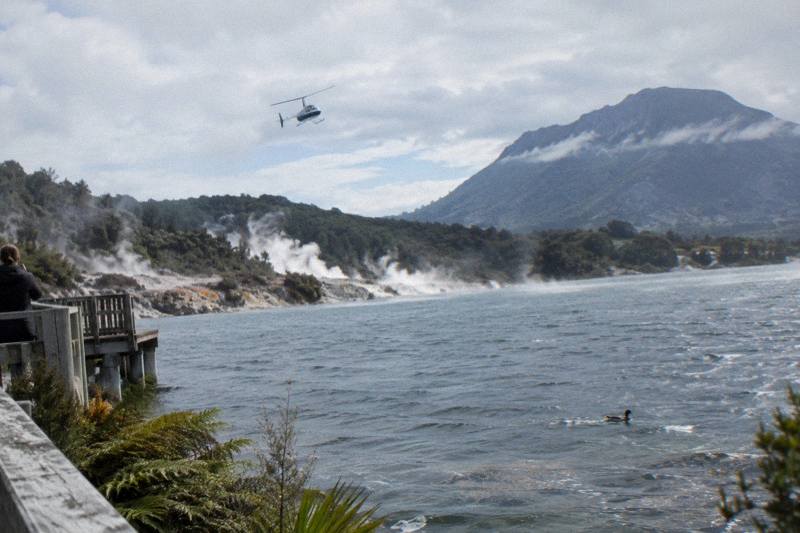
Helicopter Flight Plus Orakei Korako: What The Combo Includes
Three trips on the Rotorua line-up pair a scenic flight with Orakei Korako's geothermal valley, and the differences between them come down to aircraft, landing count and time on the ground.
Short answer
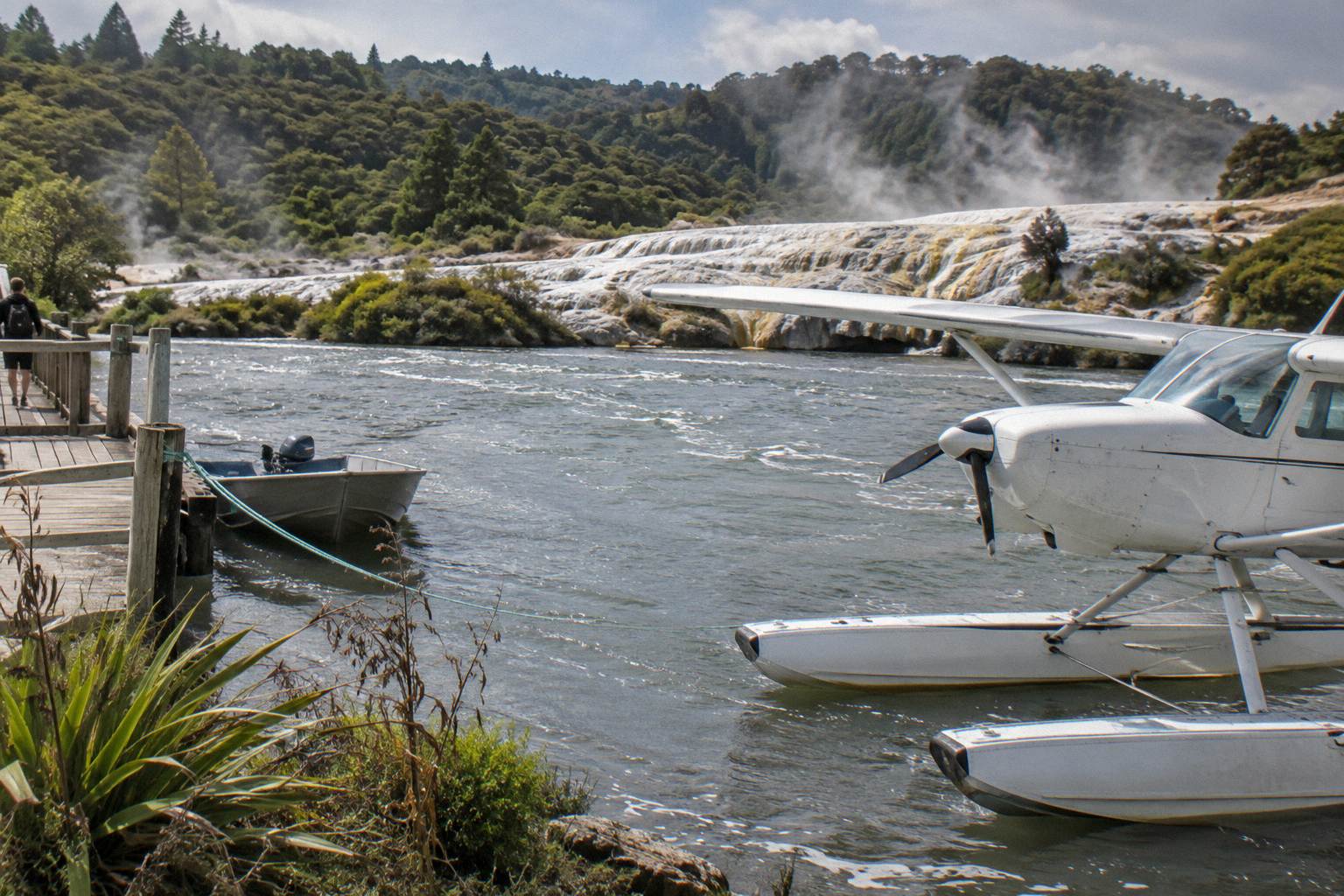
Three trips pair a flight with Orakei Korako: the Dual Landing Thermal Explorer helicopter, the Geothermal Park Landing helicopter from NZ$1,490 per person over 3 hours, and a floatplane Orakei Korako landing from NZ$845 per person over 2 hours. All three depart the Lakefront at 1 Lakefront Drive, and the geothermal field itself is reached by boat.
For the wider picture of pairing flights with geothermal parks around the city, see which Rotorua flights land at geothermal parks.
| Quick Fact | Detail |
|---|---|
| Operator | Volcanic Air, flying in the region since 1992 |
| Departure point | Lakefront, 1 Lakefront Drive, Rotorua 3010 |
| Check-in | Helicopters 30 minutes prior, floatplanes 20 minutes prior |
| Trips pairing Orakei Korako | 3 on the line-up (two helicopters, one floatplane) |
| Entry to the geothermal field | Boat crossing from the visitor centre, boats leave on request |
| Cancellation on the booking pages | Free cancellation up to 24 hours in advance |
| Weather policy | Operator reschedules or fully refunds if weather stops the flight |
What Is The Orakei Korako Combo Actually Buying You?
The combo buys two things a road trip cannot: a scenic flight across the volcanic zone between Rotorua and the Waikato River, and a touchdown at or beside a geothermal valley reached only by boat from its visitor centre. Orakei Korako sits on the Waikato River at Lake Ohakuri, between Taupo and Rotorua, and the boats leave on request rather than to a timetable.
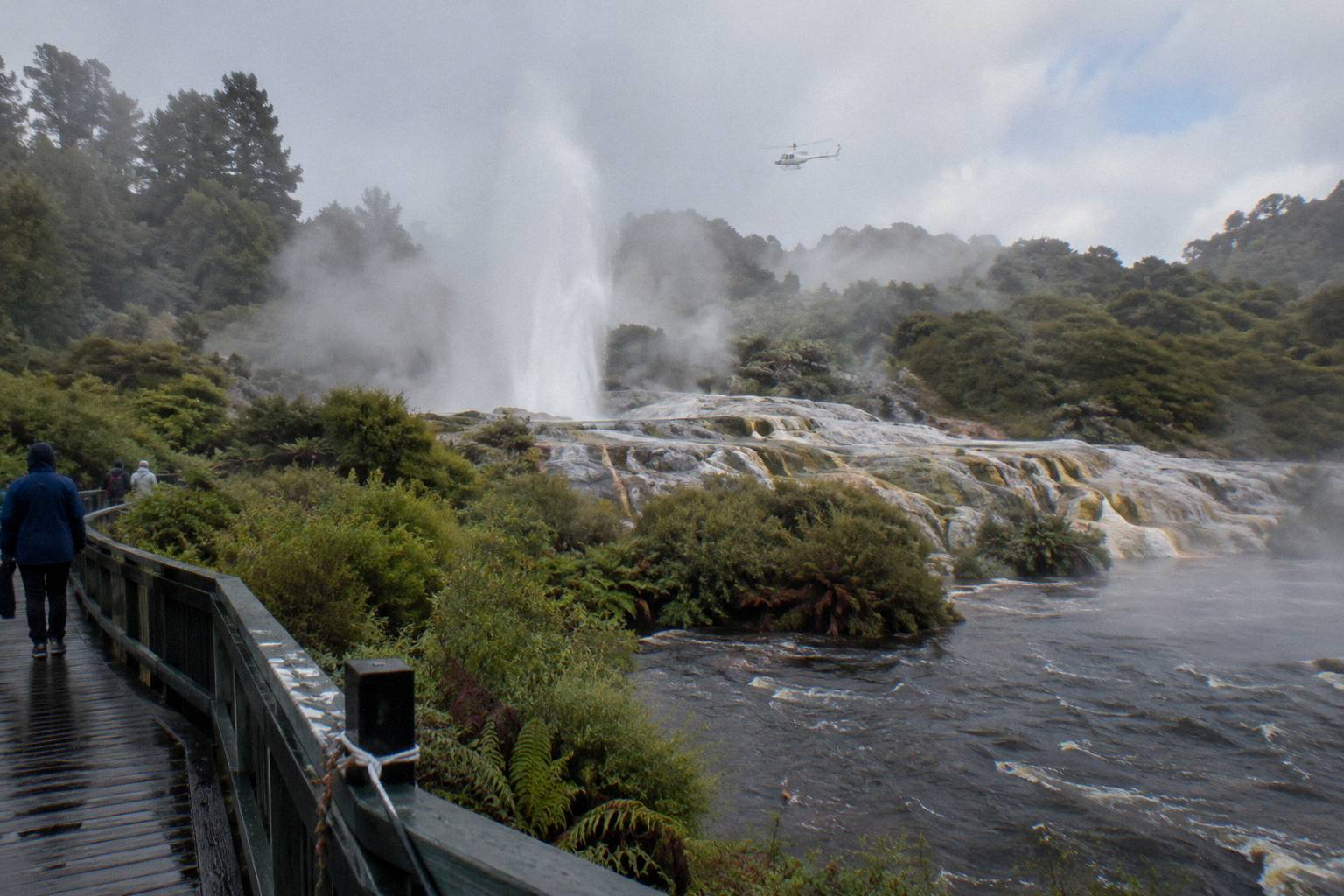
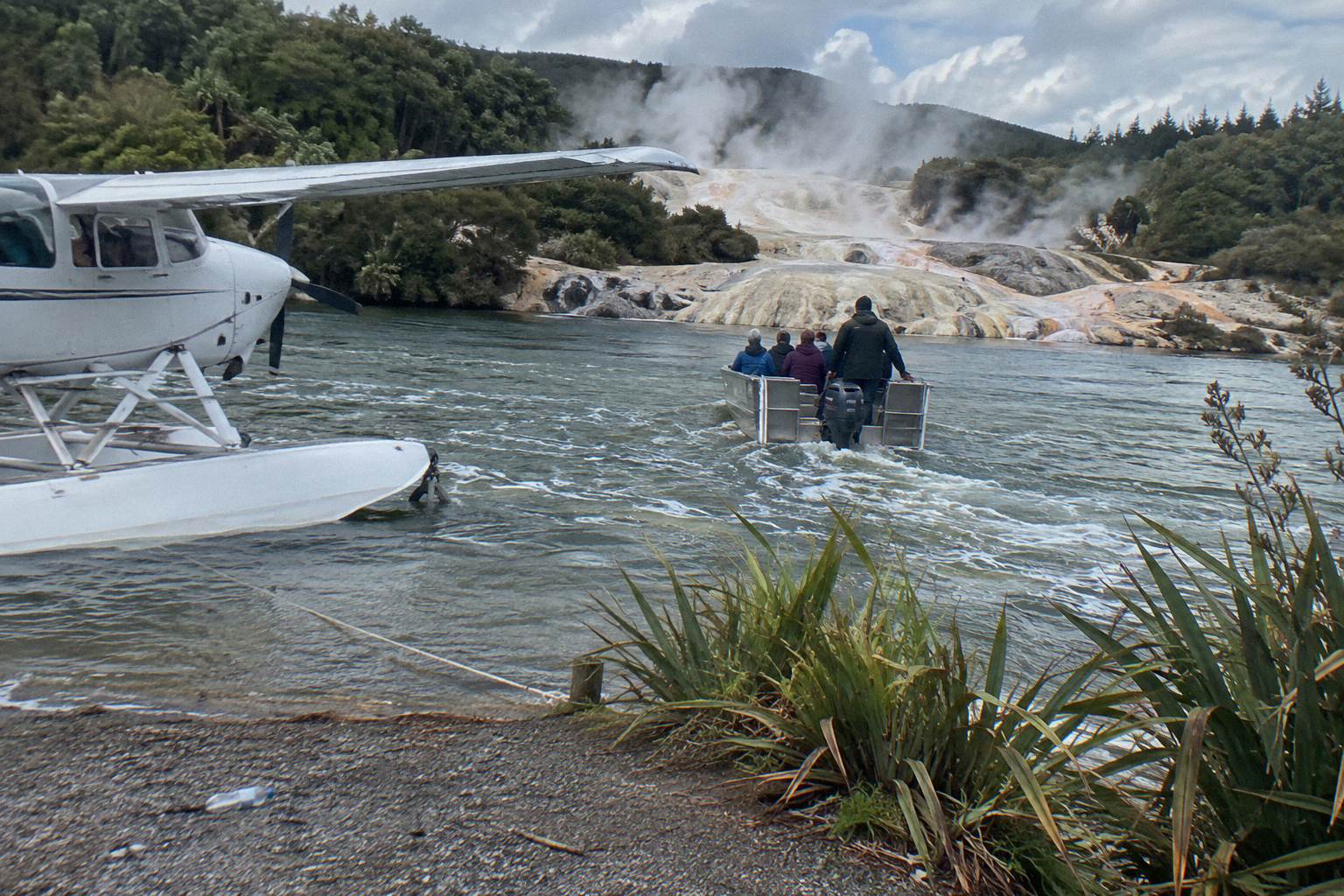
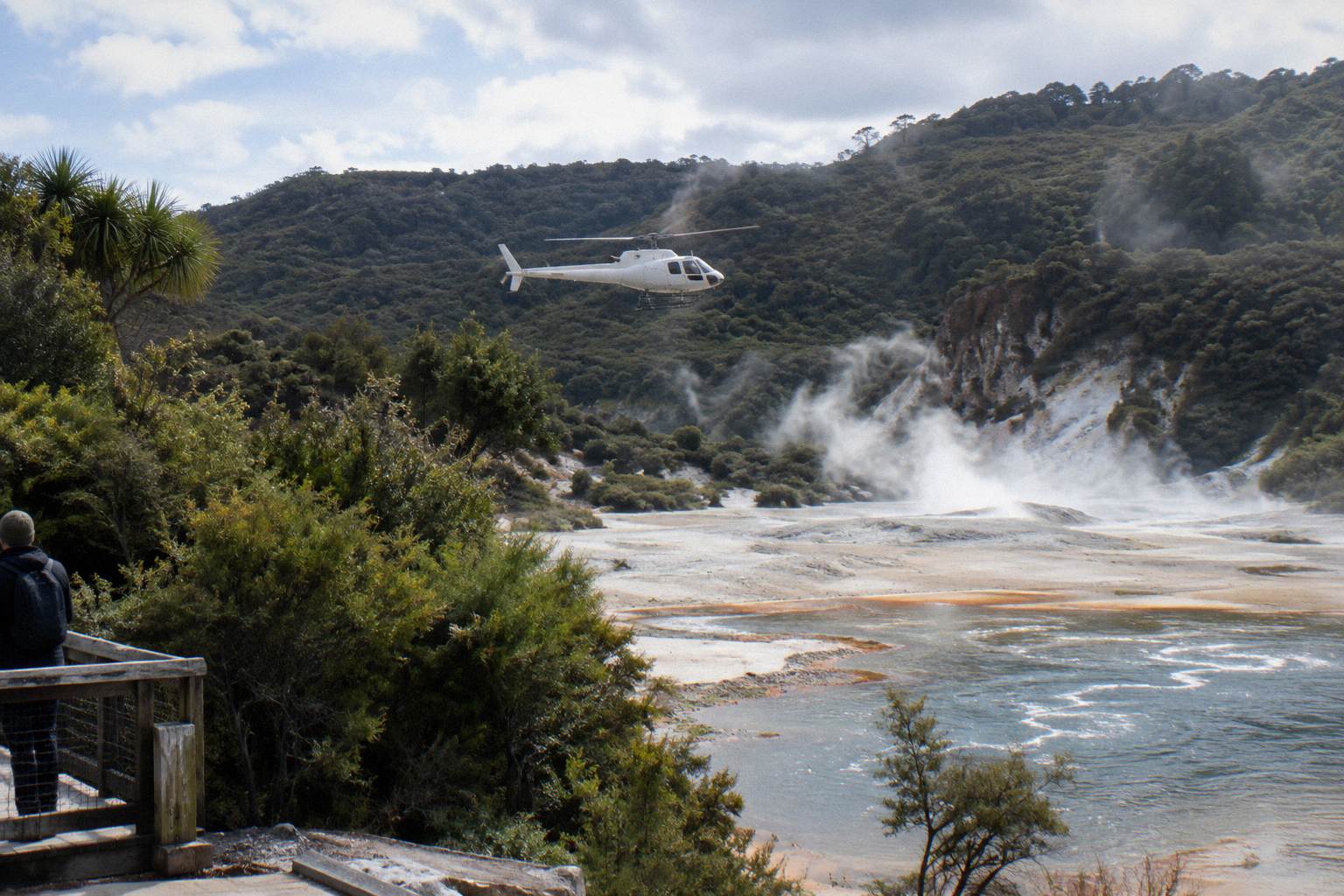
That boat-only access is the detail most first-time buyers miss. Orakei Korako is not a drive-up geothermal park where you park at the vents. The visitor centre sits on one side of Lake Ohakuri, the geothermal field sits on the other, and the crossing is part of the experience. The park describes its field as the Hidden Valley, and claims, in its own words, up to 23 active geysers and Ruatapu Cave, over 36 m deep, leading down to the Pool of Mirrors. Those are park claims rather than independent measurements, but they set expectations for the walk itself.
The flight component is not filler either. The operator's floatplane page describes the landing as a touchdown on the winding Waikato River, with the return leg crossing farmland and the Paeroa Range. Helicopter legs toward Tarawera cross lakes Okareka, Okataina and Tarawera before turning south. So the combo covers, in a single booked block, what would otherwise be a 45 minute drive each way plus a separate scenic flight plus the park visit, all sequenced by one operator out of one Lakefront base.
Whether that bundling suits you depends on how you value the flying itself. The guide on whether helicopter tours are worth the money works through that question for Rotorua specifically. If you only want the valley and would rather drive, the combo is an expensive way to arrive; if the flight is part of the point, the combo removes all the logistics between the two.
Which Flights Pair Orakei Korako With A Landing?
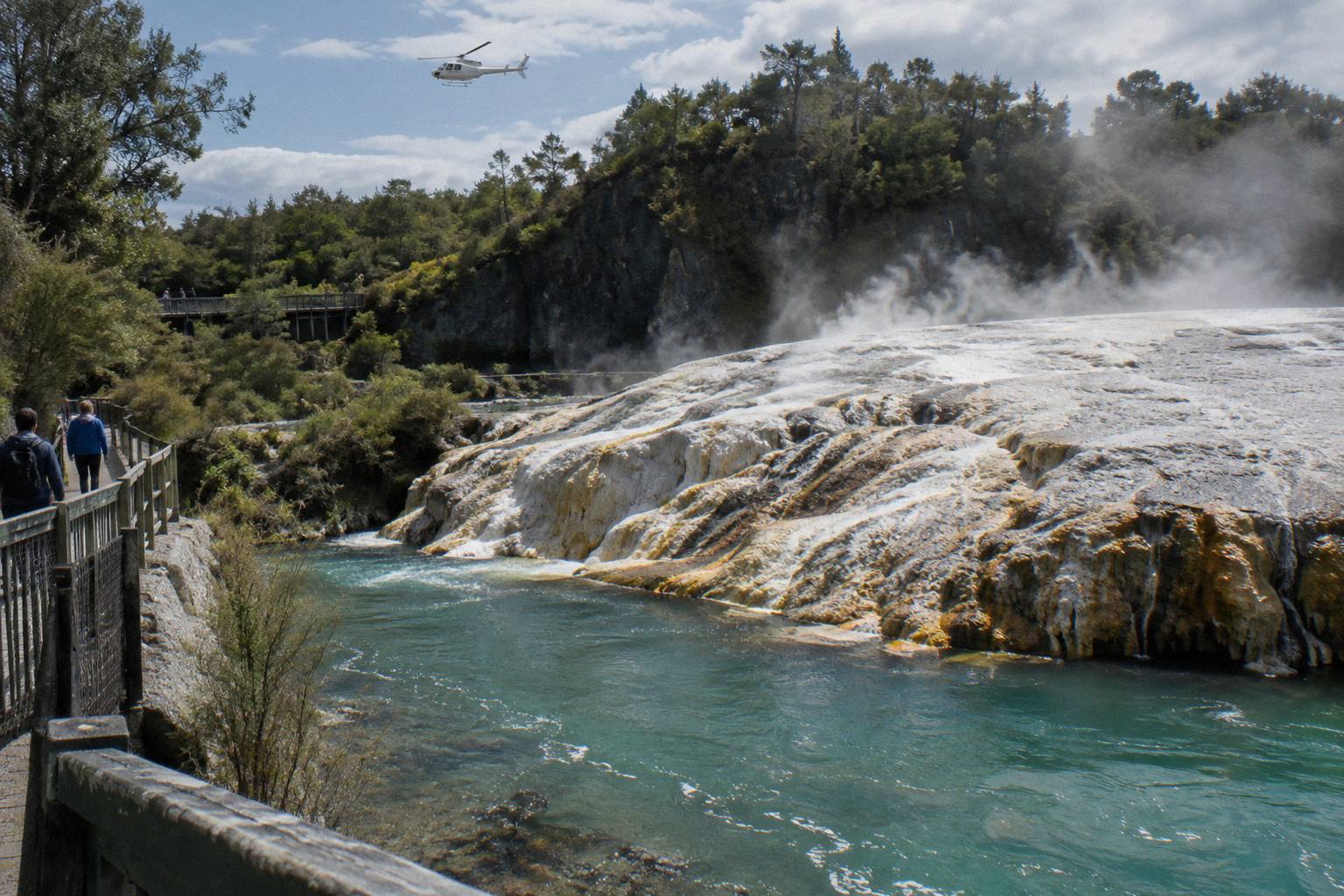
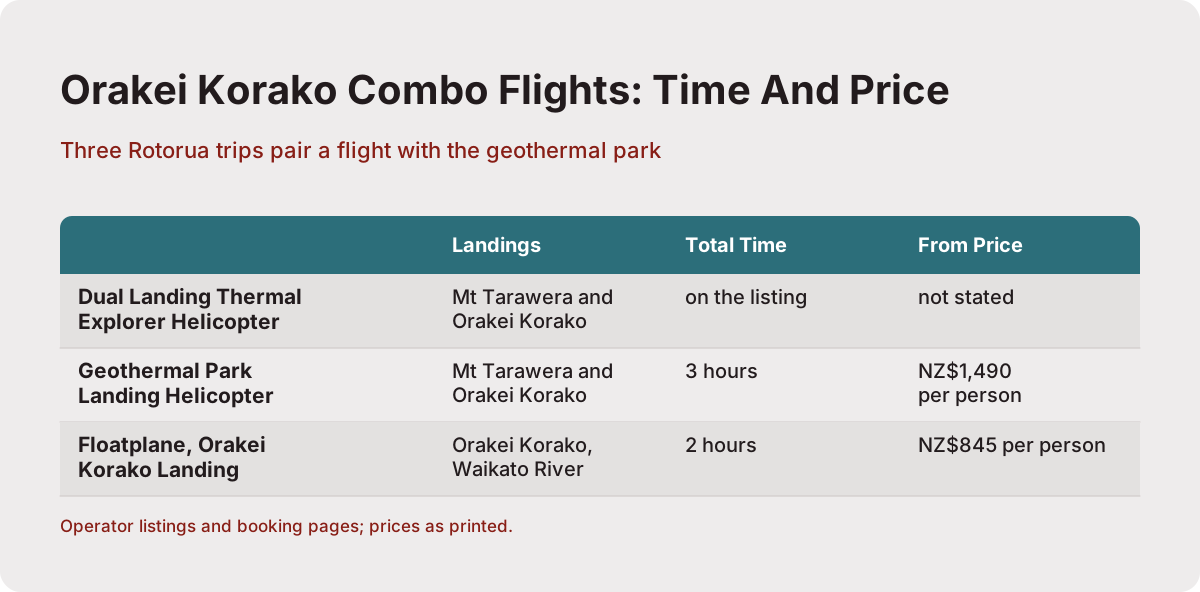
Three trips pair a flight with Orakei Korako: the Dual Landing Thermal Explorer helicopter, landing on Mt Tarawera and Orakei Korako; the Geothermal Park Landing helicopter, a 3 hour trip from NZ$1,490 per person landing on the Tarawera summit and Orakei Korako; and the Floatplane with Orakei Korako Landing, 2 hours total, from NZ$845 per person, touching down on the Waikato River. All three meet at the Lakefront and include the park crossing and walk.
The table below sets the three side by side on the facts that matter at the booking stage: aircraft, landings, total time and from-price. Note the price column prints only the booking-page from-prices; the Dual Landing Thermal Explorer carries no price, so its cell stays empty rather than guessed.
| Trip | Aircraft | Landings | Total time | From price |
|---|---|---|---|---|
| Dual Landing Thermal Explorer | Helicopter | Mt Tarawera summit and Orakei Korako | Price shown at booking | |
| Geothermal Park Landing | Helicopter | Mt Tarawera summit and Orakei Korako | 3 hours | NZ$1,490 per person |
| Floatplane, Orakei Korako Landing | Floatplane | Orakei Korako, on the Waikato River | 2 hours | NZ$845 per person |
Read the landings column carefully, because it is where the three trips genuinely diverge. Both helicopters land twice, once on the Tarawera summit and once at Orakei Korako, which makes them full-day-feeling expeditions. The floatplane lands once, on the river beside the valley, skipping Tarawera entirely. If standing on a volcano summit matters to you, the floatplane is out; if it does not, the floatplane is the cheaper and shorter way to combine flight and valley, and the helicopter versus floatplane comparison covers the flight-experience differences, windows, seating and take-off among them.
How Does The Dual Landing Thermal Explorer Actually Run?
The Dual Landing Thermal Explorer is the line-up's two-summit helicopter: it flies from the Lakefront toward Mt Tarawera, lands on the summit for a guided walk, then continues to Orakei Korako for a second landing, the boat crossing and the valley walk, before returning to Rotorua. Both landings sit at the pilot's sole discretion, subject to weather and volcanic activity, so neither touchdown is guaranteed, and the operator's own terms say excursion landings are undertaken at your own risk.
That discretion clause matters more on a dual-landing trip than anywhere else on the line-up, because there are two chances for a landing to be waved off. The operator's Mt Tarawera landing page states plainly that tour duration, flight times and inclusions may vary due to weather conditions, volcanic activity and passenger loadings, and that excursion landings are at your pilot's sole discretion. In practice a calm morning makes both landings routine; a gusty afternoon can turn the trip into a spectacular flyover with an Orakei Korako landing only. Booking with a spare morning later in your stay is the standard hedge.
The Tarawera leg also carries its own access story, one a first page of search results rarely explains. Independent summit access is not permitted; the mountain is governed by the Ruawahia 2B Trust, which reinvests most tourism concession revenue in conservation, and Volcanic Air operates as a concessionaire working alongside Ngati Rangitihi, who hold kaitiakitanga of the maunga. Your landing fee, in other words, funds the mountain's care, and an approved helicopter landing is one of the few legal ways to stand on the summit. The Mt Tarawera landing guide covers the summit walk itself.
The Orakei Korako half runs as described on the operator's floatplane page for the park: touchdown, the short ferry ride across to the field, and the walk among the geysers and terraces. The trip carries free cancellation up to 24 hours in advance on the booking terms, as every flight does, and it has a small review pool, too small to print a star rating with any confidence, so judge it on the itinerary rather than a score.
What Is The Floatplane Orakei Korako Landing Like?
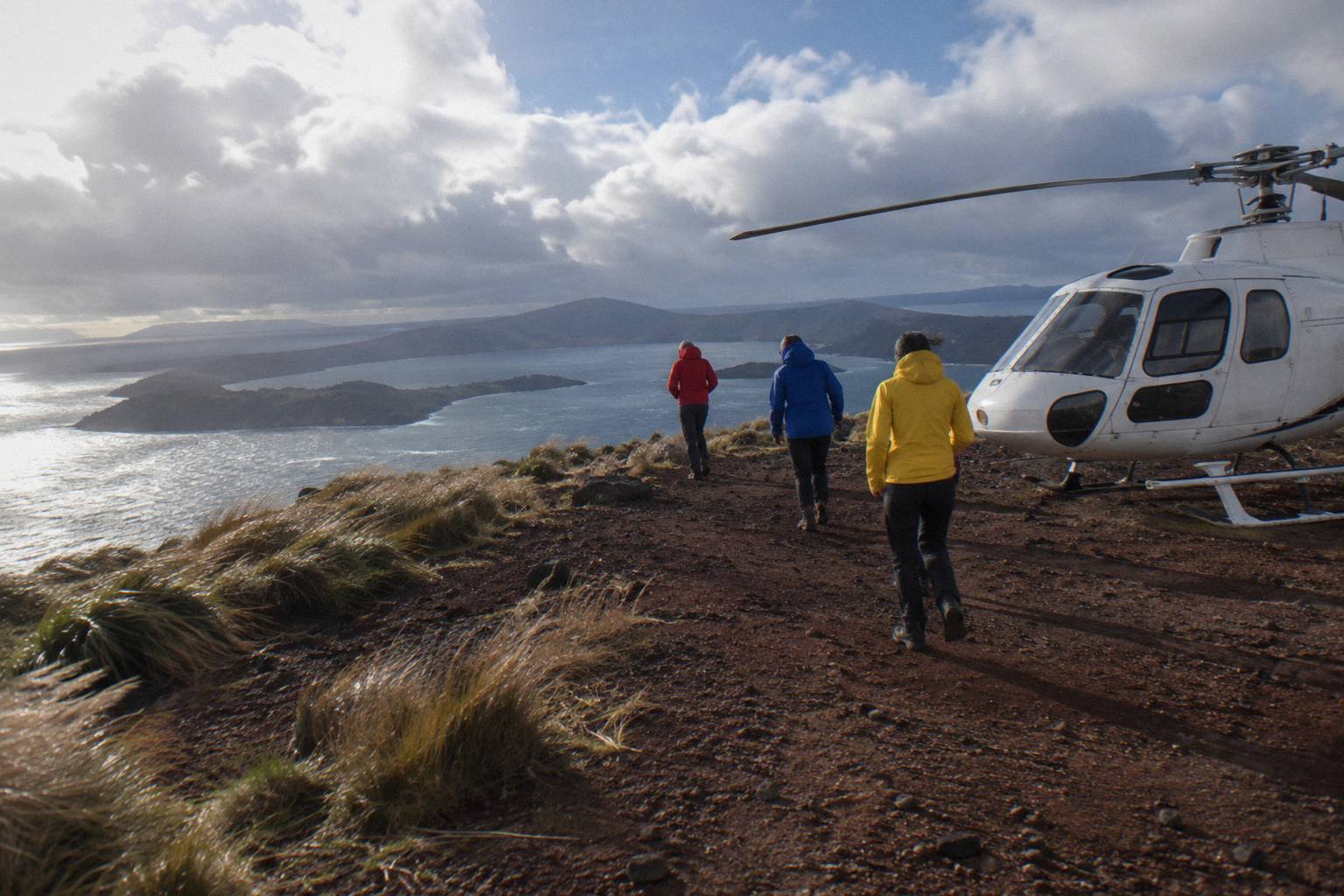
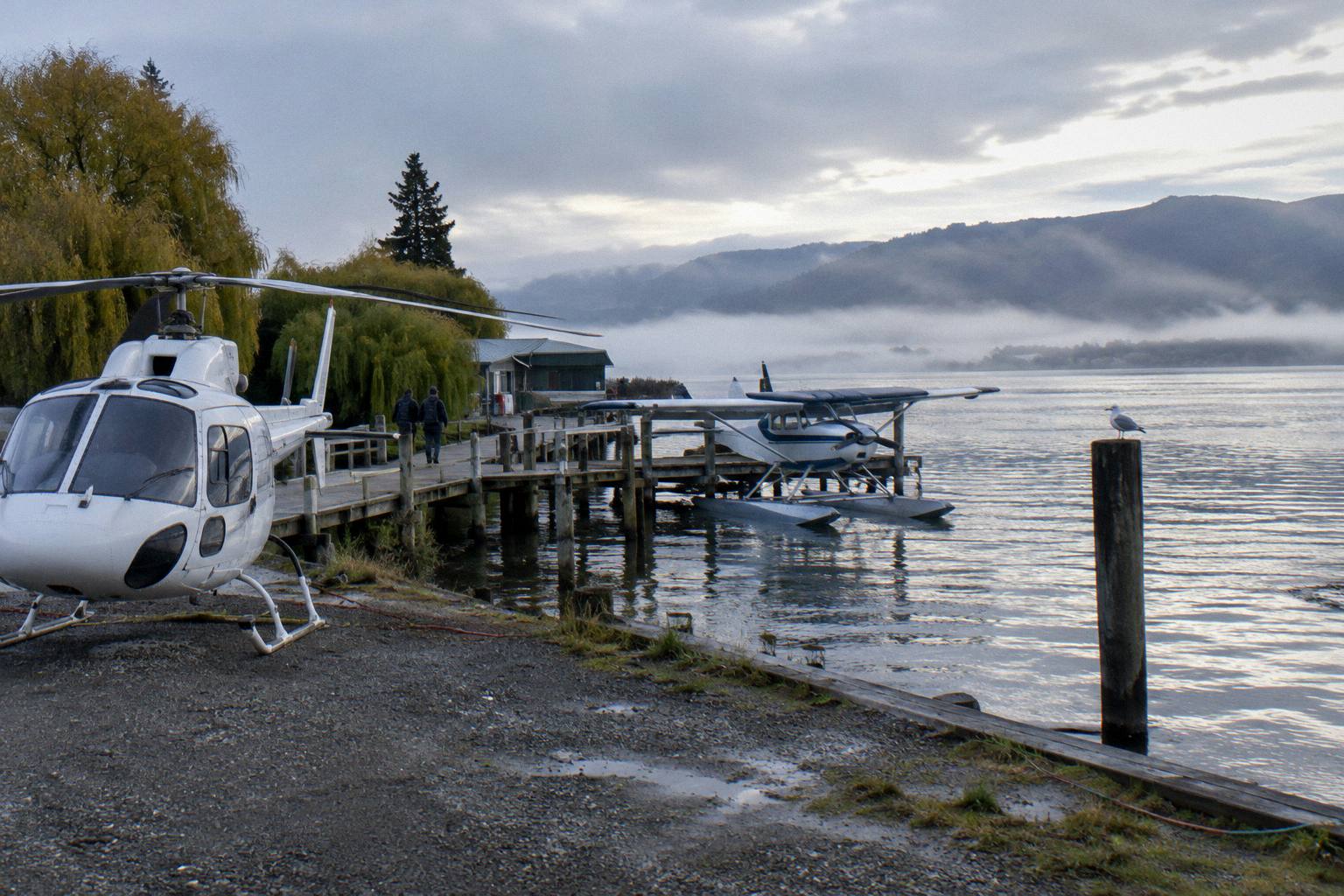
The floatplane version is the 2 hour, single-landing take on the combo: you take off from Lake Rotorua at the lakefront pier, fly south across the volcanic zone, and the pilot touches down on the winding Waikato River at the Hidden Valley, in the operator's words, before the boat crossing and valley walk. It skips the Tarawera summit and is the cheapest Orakei Korako combo at from NZ$845 per person.
Taking off from a lake rather than a pad changes the first five minutes of the trip considerably. The floatplane climbs off Lake Rotorua around Mokoia Island, which the operator describes as a native bird sanctuary, tracking Sulphur Bay and the city before heading south. Water take-offs are longer and smoother-feeling than a helicopter's vertical lift, and the cabin is a small aircraft cabin rather than an open-doored helicopter: quieter, but with window rather than door views. The Rotorua scenic flights guide compares the two ride experiences in more depth.
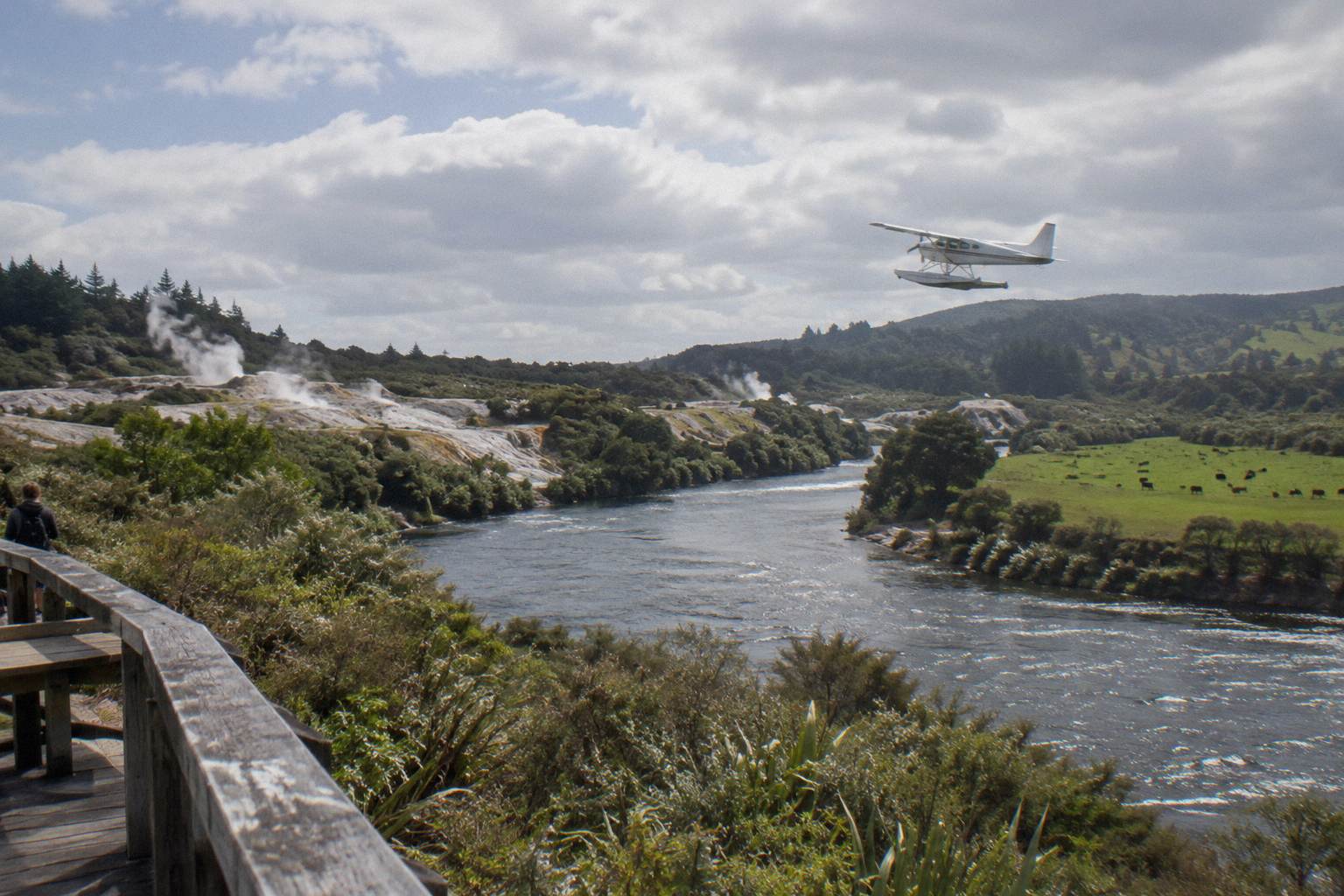
The landing is the signature moment. The operator's own page for the trip describes the pilot touching down on the river itself, taxiing to the valley access, and the return leg crossing farmland and the Paeroa Range. A river landing in a floatplane is a flat, spray-filled arrival, quite different from a helicopter's hover, and the Waikato's bends give the approach a curved, low path over the water. As with all flights, weather decides whether the trip runs, and the operator reschedules or fully refunds if it cannot.
At 2 hours total against the helicopters' longer blocks, this is the combo for a visitor who wants the valley, wants to fly, and does not want to burn half a day. The trade is the missing Tarawera landing, and only you can price that. The floatplane carries a small review pool.
What Does The Geothermal Park Landing Trip Add?
The Geothermal Park Landing helicopter is the 3 hour, most complete version: the same Mt Tarawera summit landing and the same Orakei Korako landing as the Dual Landing Thermal Explorer, in a longer block, from NZ$1,490 per person. The extra time buys a less rushed pace at both stops, and the price makes it the only Orakei Korako combo whose cost you see before checkout.
Three hours is the longest single block of the three, and the difference from the dual-landing trip is pacing rather than destinations: the same two landings, stretched. Whether that extra time is worth the gap between NZ$845 and NZ$1,490 depends almost entirely on how much you want the Tarawera summit, since the Orakei Korako half is common to all three trips. If the summit walk is the draw, the helicopter combos are the only trips that deliver it; the Tarawera crater landing value question works through that trade directly.
The helicopter format itself has practical advantages over the floatplane here. Helicopters seat fewer passengers per departure, land vertically on the crater terrain, and hold the option of doors-on vs doors-off style viewing arrangements the operator manages on the day. The weight rules bite harder, though: declare your weight at booking, expect to be weighed at check-in, and know that over 110 kg a surcharge may apply, with over 135 kg requiring two adult fares, all at the operator's discretion per its terms.
Booking-wise, the trip carries no rating or review count to print, so the itinerary is the whole pitch, and free cancellation up to 24 hours in advance matters on a weather-dependent itinerary with two discretionary landings. Given the price, booking early in a stay with fallback days is the sane play: the 24 hour window lets you bail the day before if the forecast turns, and the operator's weather policy already covers a full refund when it cancels.
What Booking Rules Apply To These Flights?
Every flight follows the same framework: check in at the Lakefront office, 30 minutes before helicopters and 20 before floatplanes, for a full safety briefing; declare each passenger's weight at booking and expect to be weighed on arrival; children of all ages are welcome, with under 2s on a lap and rates for ages 2 to 11; and if weather stops the flight, the operator reschedules or fully refunds.
Free cancellation up to 24 hours in advance applies across all three combo trips on the booking terms, and it is the single most useful clause on the page for a weather-dependent itinerary. The weight rules deserve their own paragraph because they are the most common day-of friction. The operator's terms state that any deviation from a declared weight can result in the flight being rescheduled, a surcharge being applied, or the booking being cancelled, at the operator's sole discretion. This is not bureaucracy: seating is balanced around actual weights so the aircraft stays within limits. Declare accurately, including luggage you expect to carry, and the check-in weigh-in is a two-minute formality.
Bring the practical kit the operator lists: camera, sunglasses, a jacket, and closed-toe comfortable footwear for any flight with landings, which is all three of these. Pregnancy and mobility needs are not automatic barriers, but the operator asks to be told at booking so assistance and seating can be arranged, and the safety briefing must be followed in every case. Hotel pickup is not part of standard flights; the Lakefront base is under 1 km from the Rotorua city centre, so most visitors walk it.
| Rule | What applies |
|---|---|
| Check-in | 30 minutes prior for helicopters, 20 for floatplanes, at the Lakefront office |
| Weight declaration | At booking, per passenger, with a weigh-in on arrival |
| Surcharges | Over 110 kg possible surcharge, over 135 kg two adult fares, operator discretion |
| Children | All ages, under 2 on a lap, child rates ages 2 to 11 |
| Weather cancellation | Operator reschedules or fully refunds |
| Guest cancellation | Free up to 24 hours in advance on the booking terms |
| Footwear | Closed-toe shoes for flights with landings |
When Is The Best Time To Fly This Combo?
There is no single best month: the operator flies all year during daylight hours, and its own guidance says mornings often give the calmest weather and smoothest flying, while afternoons can offer warmer temperatures and late-day colour, especially in winter. Rotorua's driest, warmest stretch runs from late spring in October to early autumn in April, but rain arrives in every month, so the day matters more than the season, and a spare fallback day matters more than either.
The rainfall record backs that up. Rotorua's monthly averages from the 1991 to 2020 normals range from 86.8 mm in November, the driest month, to 137.4 mm in July, the wettest, and even the January figure sits at 93.8 mm. In other words, the driest month is not dry, it is merely less wet, and cloud rather than rain is the real constraint for a flight whose whole point is the view. The Rotorua helicopter weather guide covers what operators do when conditions turn.
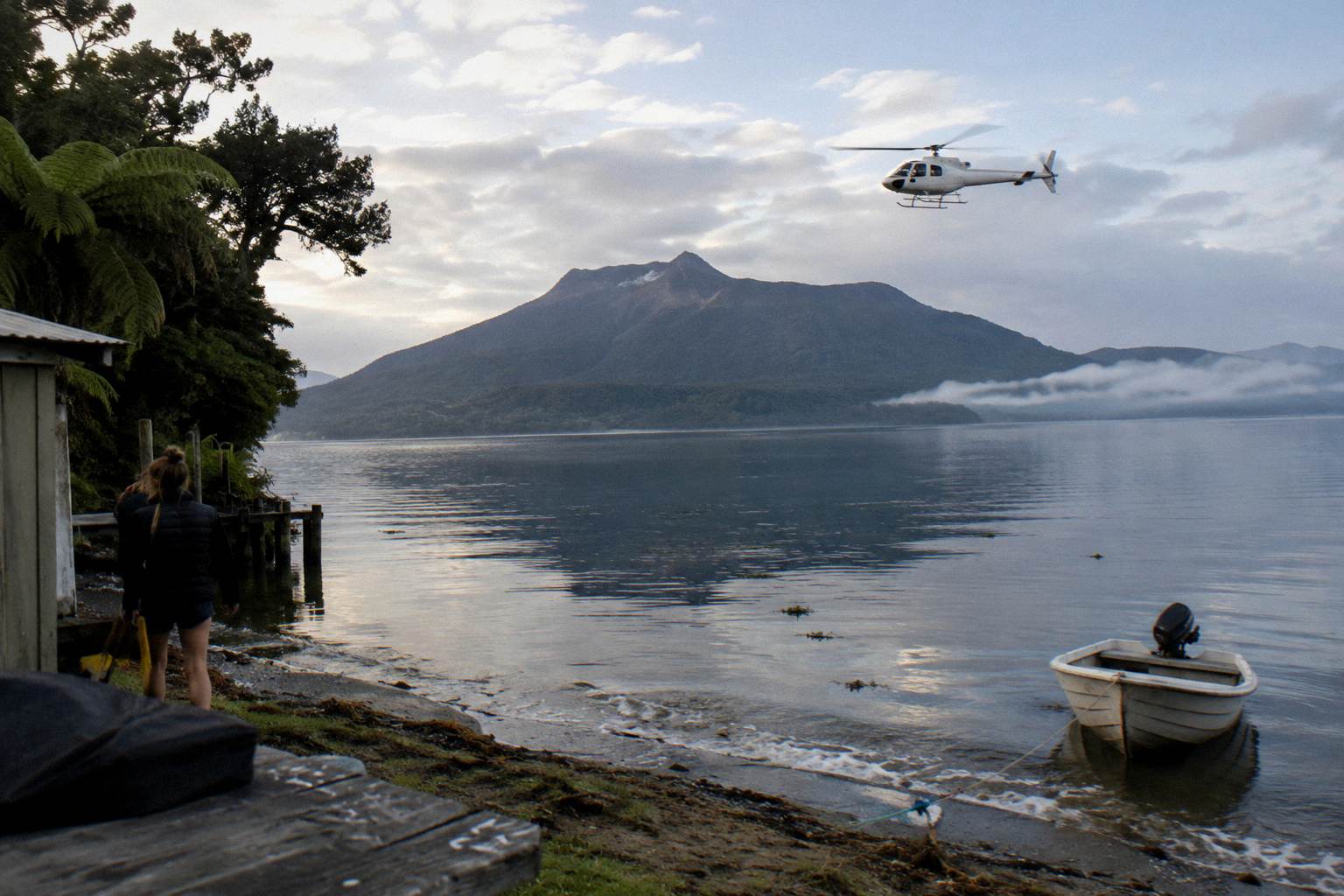
Mornings are the pragmatic choice for the dual-landing helicopters in particular, because they give you the widest window for rescheduling the same day if the first attempt is waved off. The operator's stated approach when weather is unsuitable is to try to reschedule, so a morning booking with an afternoon free doubles your chances of both landings happening on your trip. Booking any of these combos at the start of a stay rather than the end achieves the same thing.
One scheduling note: no per-product departure times are published reliably enough to print here, so treat time-of-day selection as something you arrange at booking or on arrival, and treat the morning-calms tendency as a preference to state rather than a guarantee. The one Rotorua Helicopter Tours rule worth repeating is that every one of these flights is weather dependent, in the booking pages' own words, and will not go ahead if it is not safe or the views cannot be seen.
How Do You Choose Between The Three?
Choose the Floatplane, Orakei Korako Landing for the lowest price and shortest block, from NZ$845 per person and 2 hours, with the river touchdown as the signature. Choose the Geothermal Park Landing helicopter, from NZ$1,490 over 3 hours, when you want both the Tarawera summit and a published price. Choose the Dual Landing Thermal Explorer when the itinerary, not the price tag, is what you match against your dates.
A simpler way to hold the decision: the floatplane is the valley trip with a flight attached; the two helicopters are Tarawera trips with the valley attached. If your mental picture of the day is standing on red volcanic rock at 1,111 m, you are buying a helicopter and the Orakei Korako half is a bonus. If your mental picture is the Hidden Valley's geysers, you are buying the floatplane and keeping the difference against the 3 hour helicopter's from-price in your pocket for another Rotorua day.
Parties also shape the choice. Helicopters weigh and balance each passenger and can run small groups; the One-Hour Volcanic Adventure, the line-up's related single-landing helicopter, caps at 6 travellers with a 110 kg per-passenger limit, and similar limits apply across the fleet. Larger families or anyone over the surcharge thresholds should talk weight specifics with the operator before choosing aircraft, since the floatplane's seating may spread weight differently. The family flights guide works through children's pricing in detail.
| If you want... | Book | Why |
|---|---|---|
| The cheapest way to fly plus valley | Floatplane, Orakei Korako Landing | From NZ$845 per person, 2 hours |
| Both landings and a known price | Geothermal Park Landing | From NZ$1,490 per person, Tarawera summit and Orakei Korako |
| Both landings, flexible on price | Dual Landing Thermal Explorer | Same itinerary, fare on the booking page |
| A volcano summit without the park | One-Hour Volcanic Adventure | Single Tarawera landing, shorter block |
What Mistakes Do People Make Booking Orakei Korako Flights?
The recurring mistakes are treating the landings as guaranteed, misreading the price gap between the floatplane and the helicopters as a quality gap, under-declaring passenger weights, and booking the combo on the last day of a stay with no fallback. Both Tarawera landings sit at the pilot's sole discretion, the floatplane simply skips the summit rather than delivering a lesser version of it, and weight deviations can reschedule or cancel a booking outright. All are avoidable at booking time.
The guarantee mistake is the biggest. Reading the itinerary, "land on the summit, land at Orakei Korako", it is easy to assume two touchdowns are in the contract. They are not: the operator's terms place excursion landings at your own risk and at the pilot's sole discretion, and the 24 hour free-cancellation window exists precisely so a forecast can change your plans without cost. Book early in the stay, watch the weather, and hold the fallback day.
The weight mistake is quieter and more expensive. A declared weight that drifts from the check-in scale, in the operator's words, may result in a flight being rescheduled, a surcharge being applied, or a booking being cancelled, at its sole discretion. Declare accurately per passenger, including the day's actual clothing and camera kit, and the rule never activates. And the price-gap mistake: paying more for the 3 hour helicopter only makes sense if the Tarawera summit walk is genuinely what you came for. If it is not, the floatplane is not the budget version of the same thing, it is a different, shorter, river-landing trip that fits a half-morning.
Common Questions About Orakei Korako Flights
Does The Helicopter Land Inside Orakei Korako?
The helicopters land at Orakei Korako as one of two excursion landings alongside the Mt Tarawera summit. The geothermal field itself is only accessible by boat, a short ferry ride from the visitor centre, so every trip, helicopter or floatplane, finishes the approach on the water crossing.
Which Orakei Korako Flight Is Cheapest?
The Floatplane with Orakei Korako Landing, from NZ$845 per person for 2 hours total. The Geothermal Park Landing helicopter runs from NZ$1,490 per person over 3 hours, and the Dual Landing Thermal Explorer's fare is on the booking page. All amounts are New Zealand dollars.
Is The Tarawera Landing Guaranteed On These Trips?
No. The operator's terms state that excursion landings are undertaken at your own risk and are at your pilot's sole discretion, and that duration and inclusions may vary with weather, volcanic activity and passenger loadings. Weather cancellations by the operator carry a full refund or reschedule.
Can Children Go On An Orakei Korako Combo Flight?
Yes. All ages are welcome, children under 2 sit on a parent or guardian's lap, and child rates apply for ages 2 to 11. Closed-toe comfortable footwear is recommended for flights with landings.
Where Do These Flights Leave From?
The Rotorua City Lakefront, 1 Lakefront Drive, Rotorua 3010, under 1 km from the city centre. Check in at the Lakefront office 30 minutes before a helicopter flight or 20 minutes before a floatplane flight for the safety briefing.
Can I Cancel If The Weather Looks Bad?
Yes, free of charge up to 24 hours in advance on the booking terms. If the operator cancels for weather or volcanic activity before the flight commences, the terms provide a full refund, and the FAQ says the operator will work with you to reschedule or refund.